It has been a long week. I know it has been a long time between posts, but I have been swept up in getting back to Ohio, back in the swing of things, and involved with acc-checking for the law journal. So here are some updates on things from Columbus, and next week I should have things in order enough to start book reviews, legal news, etc. again.
- Most of my time this past week has been spent either on the "acc-check", or accuracy check, for the law journal I am on, or on interviewing with firms for early OCI, or on-campus interviewing. The interviews generally went pretty well. I interviewed with four great law firms, two in Cincinnati and two in Toledo, and hopefully I will hear from them again within a few weeks.
- My last interview was on Wednesday, so most of the week was spent in the law library, and various other places, performing an acc-check on a portion of an article I was assigned. For those of you reading this who are not yet in law school, or in your first year, try to get on a law journal or law review at your school (not that I will be the only one to give you that advice). It's one of the best resume-builders you can have, and it's a learning experience that will help make you a better lawyer after you graduate.
Case in point...the article I acc-checked dealt with a narrow issue in patent law, which is traditionally an area I don't know much about. But I was able to get at least a basic grounding in it just by proofreading an article written by a law professor who knows the subject well. Even if you're not planning to practice in that specialized an area of law, it's a good idea to know as much as you can about any subject, the more the better. To quote one of my first-year professors, "the law is a seamless web," and you would be surprised at how much interrelatedness there is between subjects that would seem to be far apart.
It's true, being on a journal or law review involves a lot of work. I put in a substantial amount of time on the assignment (about as much as a part-time work week). But it's like any other story or rumor you hear-a grain of truth wrapped in a big ball of exaggeration. The truth is, I enjoyed different aspects of the acc-check, such as proofreading the article and checking the accuracy of quotations, because I have always had a good eye for editing. In high school, I worked in my school's Writing Lab, proofreading papers for the freshman and sophomore English Composition students, and it was always fulfilling to me to help people improve their grades by helping them with grammar and style. I enjoyed the acc-check because it took me back to the good old days, if only temporarily. I can tell I am going to enjoy it, and the work is well worth the experience.
- I am going to have one last "summer of 2006" post sometime next week, probably Monday or Tuesday (but no guarantees because of how hectic things are right now), where I will discuss the Blackstone and the Phase III experiences in more detail.
- Other than the journal work and interviews, not much else of note to report this week. Things will start to get back on a normal pace next week, since classes start Tuesday, but at least I have this weekend, one more weekend of freedom before it's back to the classroom.
Saturday, August 19, 2006

Monday, August 07, 2006
Summer of 2006, pt. 10
Now back in Phoenix for Phase III:
- I showed my devotion to country music today. We had a talent show tonight, the Fellowship Follies, that had just about everything. The highlights for me were a tuxedo-clad harmonica player, a performance of the "who's on first" routine by Abbott and Costello, and a hilarious video some of the interns put together about their experience in Dallas, a parody of "The Real World." But first prize goes to my rendition of Toby Keith's "How Do You Like Me Now" that definitely brought down the house.
I sing loudly. I couldn't find the karaoke tape in Phoenix, so I just bought the CD and sang over it. At least one person told me afterwards that they never heard the vocals from the CD. That means I still have it-the booming bass from high school choir and madrigals.
It seems like the older I get, the less I listen to new music. Some of it I like (the exceptions to this rule are Christian and country), but most of it just isn't as good. I started out with Tears For Fears and Modern English from the 80's, and now I listen to classic country, 70's, and Motown. Eventually I am going to be listening to those old hand-cranked record players (Victrollas maybe, but I'm not sure what they're called) and tape recording a bard.
- Reading wise, I just started reading "The Pilgrim's Progress" by John Bunyan yesterday. It might take a week or two to get through it, but I will have a post on it soon. The books in the reading queue now are, in this order: "The Myth of a Christian America" by Rev. Gregory Boyd (not agreeing, but I will read it to address the arguments made by the other side). Ron Chernow's biography on Alexander Hamilton, and then I plan to begin reading Blackstone's "Commentaries." Instead of reviewing Blackstone, I will try to weave summaries into my general posts.
- Journal orientation began today, 1,800 miles from where I am now. I read the style guide today to get caught up on the editing work we will be doing this year, so I know a little more about the gargantuan editing assignment (and gargantuan to-do list) that will be waiting for me when I get back to Columbus.
- We haven't gotten into the lecture portion of Phase III yet, but it's supposed to be fantastic, with many prominent members of the legal community coming in to present for us. Many of the presentations will involve building personal and professional relationships-how to get a clerkship, how to become a Blackstone Fellow, and so on. More as the week unfolds.
- I showed my devotion to country music today. We had a talent show tonight, the Fellowship Follies, that had just about everything. The highlights for me were a tuxedo-clad harmonica player, a performance of the "who's on first" routine by Abbott and Costello, and a hilarious video some of the interns put together about their experience in Dallas, a parody of "The Real World." But first prize goes to my rendition of Toby Keith's "How Do You Like Me Now" that definitely brought down the house.
I sing loudly. I couldn't find the karaoke tape in Phoenix, so I just bought the CD and sang over it. At least one person told me afterwards that they never heard the vocals from the CD. That means I still have it-the booming bass from high school choir and madrigals.
It seems like the older I get, the less I listen to new music. Some of it I like (the exceptions to this rule are Christian and country), but most of it just isn't as good. I started out with Tears For Fears and Modern English from the 80's, and now I listen to classic country, 70's, and Motown. Eventually I am going to be listening to those old hand-cranked record players (Victrollas maybe, but I'm not sure what they're called) and tape recording a bard.
- Reading wise, I just started reading "The Pilgrim's Progress" by John Bunyan yesterday. It might take a week or two to get through it, but I will have a post on it soon. The books in the reading queue now are, in this order: "The Myth of a Christian America" by Rev. Gregory Boyd (not agreeing, but I will read it to address the arguments made by the other side). Ron Chernow's biography on Alexander Hamilton, and then I plan to begin reading Blackstone's "Commentaries." Instead of reviewing Blackstone, I will try to weave summaries into my general posts.
- Journal orientation began today, 1,800 miles from where I am now. I read the style guide today to get caught up on the editing work we will be doing this year, so I know a little more about the gargantuan editing assignment (and gargantuan to-do list) that will be waiting for me when I get back to Columbus.
- We haven't gotten into the lecture portion of Phase III yet, but it's supposed to be fantastic, with many prominent members of the legal community coming in to present for us. Many of the presentations will involve building personal and professional relationships-how to get a clerkship, how to become a Blackstone Fellow, and so on. More as the week unfolds.
Wednesday, August 02, 2006
Reading: "Alexander Hamilton: American"
I am going to have to go back on what I said in an earlier post. I originally planned to read Richard Brookhiser’s and Ron Chernow’s biographies and review them in one post. Unfortunately, tonight is my last night in Cincinnati, with my copy of Brookhiser’s book. So I will review them separately.
Brookhiser’s “Alexander Hamilton, American” is a detailed portrait of the Founding Father, bringing together each of the stages of his life-his childhood in St. Croix, his arrival in America and service in the Continental Army, and his political (and often legal) conflicts-in psychological and philosophical terms. Brookhiser has an interesting way of putting the biography together, by linking together the various influences on his life to paint a picture of someone whom one might say was an intellectual more than a politician, and a Platonic philosopher-king more than a general. In this way, I believe that Brookhiser’s biography stands not just as a portrait of Hamilton, but of American society itself at the time. Many of those same ideas, those same patterns of thinking, influence us as much as they did our forefathers over 200 years ago. Some thoughts I had about one specific passage:
“The inspired leader can tell a man something he did not know about himself: that he is brave, that he is willing to die. The flatterer tells him what he has already heard, and wants to hear again. Inspiration stimulates virtue; flattery induces contentment.”(p. 167)
How far you go in life depends on what you say to yourself mentally. Different experts call it different things, but in the end, it’s simply how you view yourself, what you are willing to tell yourself to keep going, and how you relate to others. I believe that what the author says here about the difference between inspiration and flattery is relevant to what’s on your mind, and not just what’s on your ballot. It’s a simple distinction: if you are willing to tell yourself the things you need to hear-that you are strong, that you are confident, etc.-then you are going to get ahead in life, at least of the people who don’t. But if you are a self-flatterer, meaning that you tell yourself what you want to hear just to silence the part of you wanting something else, this will keep you in neutral.
How do you know whether you flatter or inspire yourself through your thoughts? I believe it all depends on how comfortable you are with your assumptions, biases, and preconceived notions. If you run through the “inspiring” things that we say-that we are strong, we can get through this difficulty, we know better than to do what we’re doing-most of them are things we usually don’t want to hear. None of us want to hear that we are strong enough to get through a problem; the sinful, human side wants the mountain to go away, rather than for us to have the strength to climb over it. This is even more true when we act in opposition to what we know is right, or in indulging what we know is wrong. The “inspired” side of you tells you what is on your heart-guard your loved one’s heart with your words, take care of the people around, stay away from that addiction. We can implicitly recognize that there is something affirmatively good about the “inspiring” things of life, even when we don’t understand why.
Inspiration is the conscience, and self-flattery is the enemy of the soul.
I recognize that in the end, all of this is circular. We have traveled from the demise of the Roman Republic (Cato “resisted” the people with inspiration to a higher good, as Hamilton put it, while Caesar destroyed the Republic as he resorted to flattery) to the Founding, to today’s inner battle against darkness, and back to the days of Plato, Aristotle, and Socrates, some of the first men to recognize the moral implications of politics and rhetoric. I made this journey to stress two points that I think Brookhiser touched on succinctly. One, that there is a critical link between what we perceive as just and good, secular and sacred, public and private, because the normative study of political rhetoric is indistinguishable from study of the antithesis, the conflict within the soul. Two, that even though they are linked, they are apart. Our politics and our civil government can bring peace and prosperity, but they can never solve the problem of sin and bridge the gap between God’s holiness and our own depravity. Maybe this is why Jesus told us to render unto Caesar-that even though our role in public life is to externalize God’s redeeming love, that our ultimate focus should be to place ourselves at the foot of the Cross.
Overall, a decent read if you are interested in biographies on the Founders. I may comment some more after I have read another of Hamilton’s biographies, by Ron Chernow.
Brookhiser’s “Alexander Hamilton, American” is a detailed portrait of the Founding Father, bringing together each of the stages of his life-his childhood in St. Croix, his arrival in America and service in the Continental Army, and his political (and often legal) conflicts-in psychological and philosophical terms. Brookhiser has an interesting way of putting the biography together, by linking together the various influences on his life to paint a picture of someone whom one might say was an intellectual more than a politician, and a Platonic philosopher-king more than a general. In this way, I believe that Brookhiser’s biography stands not just as a portrait of Hamilton, but of American society itself at the time. Many of those same ideas, those same patterns of thinking, influence us as much as they did our forefathers over 200 years ago. Some thoughts I had about one specific passage:
“The inspired leader can tell a man something he did not know about himself: that he is brave, that he is willing to die. The flatterer tells him what he has already heard, and wants to hear again. Inspiration stimulates virtue; flattery induces contentment.”(p. 167)
How far you go in life depends on what you say to yourself mentally. Different experts call it different things, but in the end, it’s simply how you view yourself, what you are willing to tell yourself to keep going, and how you relate to others. I believe that what the author says here about the difference between inspiration and flattery is relevant to what’s on your mind, and not just what’s on your ballot. It’s a simple distinction: if you are willing to tell yourself the things you need to hear-that you are strong, that you are confident, etc.-then you are going to get ahead in life, at least of the people who don’t. But if you are a self-flatterer, meaning that you tell yourself what you want to hear just to silence the part of you wanting something else, this will keep you in neutral.
How do you know whether you flatter or inspire yourself through your thoughts? I believe it all depends on how comfortable you are with your assumptions, biases, and preconceived notions. If you run through the “inspiring” things that we say-that we are strong, we can get through this difficulty, we know better than to do what we’re doing-most of them are things we usually don’t want to hear. None of us want to hear that we are strong enough to get through a problem; the sinful, human side wants the mountain to go away, rather than for us to have the strength to climb over it. This is even more true when we act in opposition to what we know is right, or in indulging what we know is wrong. The “inspired” side of you tells you what is on your heart-guard your loved one’s heart with your words, take care of the people around, stay away from that addiction. We can implicitly recognize that there is something affirmatively good about the “inspiring” things of life, even when we don’t understand why.
Inspiration is the conscience, and self-flattery is the enemy of the soul.
I recognize that in the end, all of this is circular. We have traveled from the demise of the Roman Republic (Cato “resisted” the people with inspiration to a higher good, as Hamilton put it, while Caesar destroyed the Republic as he resorted to flattery) to the Founding, to today’s inner battle against darkness, and back to the days of Plato, Aristotle, and Socrates, some of the first men to recognize the moral implications of politics and rhetoric. I made this journey to stress two points that I think Brookhiser touched on succinctly. One, that there is a critical link between what we perceive as just and good, secular and sacred, public and private, because the normative study of political rhetoric is indistinguishable from study of the antithesis, the conflict within the soul. Two, that even though they are linked, they are apart. Our politics and our civil government can bring peace and prosperity, but they can never solve the problem of sin and bridge the gap between God’s holiness and our own depravity. Maybe this is why Jesus told us to render unto Caesar-that even though our role in public life is to externalize God’s redeeming love, that our ultimate focus should be to place ourselves at the foot of the Cross.
Overall, a decent read if you are interested in biographies on the Founders. I may comment some more after I have read another of Hamilton’s biographies, by Ron Chernow.
Tuesday, August 01, 2006
Summer of 2006, pt. 9
I need to get better at coming up with titles for these posts...
- I have almost come to the end of my stint in the Queen City. My last day at the office is Thursday, and then I will be heading home to see my family for the first time in about a month.
On Sunday, I visited the Taft Museum of Art, not far from the riverfront and the Great American Ballpark. I will have pictures on here soon-it's a beautiful old house, and each room contains a separate exhibit, and is decorated according to period styles. I wasn't able to take pictures inside, but the decor was amazing-there was a mural painted on the wall in the "historic wing" of the building, complete with Roman-like busts of the two members of the Taft family for whom the museum was named. Also, the collection contained a variety of types of artwork, everything from the Italian Renaissance to more recent English paintings of the nineteenth century. The rooms also had historic furniture, beautifully restored-coffee tables from 1810, sofas from 1815, and others.
The highlights for me were fivefold. First, my favorite area was a room dedicated to works from American history. There was a painting of George Washington, and a collection of small watercolor paintings on what looked like lockets, or watch chains. These were extremely detailed portraits of every president from Washington to Herbert Hoover. Also, it was impressive for me to see a painting by Rembrandt. It was of an everyday subject (a well-dressed gentleman), but looking at it was like listening to Beethoven's Ninth Symphony or reading Shakespeare-you knew you were looking at a work of genius.
My two other favorites were the portrait of President Taft, and the current exhibit at the Taft Museum, art from medieval China (that is, China during the medieval period in Europe). The exhibit on Chinese art was interesting in how it showed the different patterns, and methods of production, used to produce tea bowls, cups, jugs, and other articles. One in particular used a special method of cooling glass, so that the surface of the bowl almost looked as though someone had poured glitter on it, for that "sparkling" texture.
The house itself was beautiful. I got to walk through the garden for a few minutes before I left, although I didn't stay there long on account of the heat. Next door was a nice garden, in Lytle Park-I walked over for a few minutes before I had to go cool off.
- The other aspect of Cincinnati culture I have tried this week is Skyline Chili. It's got a different flavor to it, almost kind of like maple. I have been to LaRosa's a few times, and had their pizza and pasta. I definitely recommend it, and Skyline if you like good chili.
- I hope the heat wave dies down soon. It has been searingly hot outside the last two weeks-today I was driving home from work, at 6:30 in the evening, and the temperature was still 96 degrees outside. And the humidity makes it even worse.
People in Ohio tend to joke about the weather in Arizona, because everyone here thinks it is the most extreme form of heat, like an outdoor oven. I tell them that even though it gets hot in Phoenix (highs of about 110 when I was there in June) Ohio is actually more uncomfortable when the temperature is 85 or 90 with 95% humidity. It's the moisture in the air that makes it miserable, not the number on the thermometer. In Phoenix, you hardly even notice that you're sweating, because your body has the dry air to cool off.
Here in Ohio, when the humidity goes up, it gets much harder to handle. I am actually looking forward to spending a few days in the dry heat; it will be a relief from the heat and humidity here. But you know what they say about Ohio weather-wait 5 minutes and it will change.
- I have almost come to the end of my stint in the Queen City. My last day at the office is Thursday, and then I will be heading home to see my family for the first time in about a month.
On Sunday, I visited the Taft Museum of Art, not far from the riverfront and the Great American Ballpark. I will have pictures on here soon-it's a beautiful old house, and each room contains a separate exhibit, and is decorated according to period styles. I wasn't able to take pictures inside, but the decor was amazing-there was a mural painted on the wall in the "historic wing" of the building, complete with Roman-like busts of the two members of the Taft family for whom the museum was named. Also, the collection contained a variety of types of artwork, everything from the Italian Renaissance to more recent English paintings of the nineteenth century. The rooms also had historic furniture, beautifully restored-coffee tables from 1810, sofas from 1815, and others.
The highlights for me were fivefold. First, my favorite area was a room dedicated to works from American history. There was a painting of George Washington, and a collection of small watercolor paintings on what looked like lockets, or watch chains. These were extremely detailed portraits of every president from Washington to Herbert Hoover. Also, it was impressive for me to see a painting by Rembrandt. It was of an everyday subject (a well-dressed gentleman), but looking at it was like listening to Beethoven's Ninth Symphony or reading Shakespeare-you knew you were looking at a work of genius.
My two other favorites were the portrait of President Taft, and the current exhibit at the Taft Museum, art from medieval China (that is, China during the medieval period in Europe). The exhibit on Chinese art was interesting in how it showed the different patterns, and methods of production, used to produce tea bowls, cups, jugs, and other articles. One in particular used a special method of cooling glass, so that the surface of the bowl almost looked as though someone had poured glitter on it, for that "sparkling" texture.
The house itself was beautiful. I got to walk through the garden for a few minutes before I left, although I didn't stay there long on account of the heat. Next door was a nice garden, in Lytle Park-I walked over for a few minutes before I had to go cool off.
- The other aspect of Cincinnati culture I have tried this week is Skyline Chili. It's got a different flavor to it, almost kind of like maple. I have been to LaRosa's a few times, and had their pizza and pasta. I definitely recommend it, and Skyline if you like good chili.
- I hope the heat wave dies down soon. It has been searingly hot outside the last two weeks-today I was driving home from work, at 6:30 in the evening, and the temperature was still 96 degrees outside. And the humidity makes it even worse.
People in Ohio tend to joke about the weather in Arizona, because everyone here thinks it is the most extreme form of heat, like an outdoor oven. I tell them that even though it gets hot in Phoenix (highs of about 110 when I was there in June) Ohio is actually more uncomfortable when the temperature is 85 or 90 with 95% humidity. It's the moisture in the air that makes it miserable, not the number on the thermometer. In Phoenix, you hardly even notice that you're sweating, because your body has the dry air to cool off.
Here in Ohio, when the humidity goes up, it gets much harder to handle. I am actually looking forward to spending a few days in the dry heat; it will be a relief from the heat and humidity here. But you know what they say about Ohio weather-wait 5 minutes and it will change.
Sunday, July 30, 2006
On Engaging the Community, pt. 1
Every once in a while, more than it should really, a case comes up in the media of another Christian, or conservative, deciding not to engage in helping change the culture. It has happened again, this time in Minnesota.
The Rev. Gregory Boyd pastors Woodland Hills Church in St. Paul, with a large congregation that, until recently, had as many as 5,000 in attendance every Sunday. According to an article published by Laurie Goodstein of the New York Times, he is pro-life and "believes that homosexuality is not God's ideal." Yet at the same time, he has staked out a position that today's evangelical Christian involvement in politics is too nationalistic, even idolatrous.
Here is the source, from AOL: Laurie Goodstein, "Disowning Conservative Politics Is Costly for Pastor," The New York Times, July 30, 2006. Found at http://articles.news.aol.com/news/_a/disowning-conservative-politics-is/20060729195809990004?ncid=NWS00010000000001.
According to the article, to illustrate his points, he delivered a series of six sermons before the 2004 presidential election, entitled "The Cross and the Sword." This was a call for the church to disengage from politics and the culture war, particularly in claiming that America is a Christian nation, and in opposition to homosexuality and other forms of sexual immorality expressed in the culture at large. It seems that the Rev. Boyd’s rationale for this is that the church has become too intertwined with patriotism, the Republican Party, and support for the U.S. military.
Before I go any further, I want to be clear about two things. One, though I strongly disagree with what I have read so far, I am not going to refute arguments I have not fully heard. It would not be fair to anyone reading this, or to the Rev. Boyd, for me to denounce his ideas before I have had a chance to first determine how he has chosen to articulate his position. Therefore, I will address what he says after I have done some research, probably posting sometime in the next few weeks.
Two, I will say up front what you can expect from me. I am going to give a passionate demonstration of Truth through what I write here. This means that I am not going to dismiss the arguments of the other side through emotional appeals, but instead question assumptions through the use of Scripture and sound doctrine. It means that I am not going to lash out in anger via the written word, but that I will try my best to speak the truth in love, against the sin and for the sinner. And it means that what you read here will be the best way I can make the case for why Christians can, and should, engage others in public as well as private life.
The Rev. Gregory Boyd pastors Woodland Hills Church in St. Paul, with a large congregation that, until recently, had as many as 5,000 in attendance every Sunday. According to an article published by Laurie Goodstein of the New York Times, he is pro-life and "believes that homosexuality is not God's ideal." Yet at the same time, he has staked out a position that today's evangelical Christian involvement in politics is too nationalistic, even idolatrous.
Here is the source, from AOL: Laurie Goodstein, "Disowning Conservative Politics Is Costly for Pastor," The New York Times, July 30, 2006. Found at http://articles.news.aol.com/news/_a/disowning-conservative-politics-is/20060729195809990004?ncid=NWS00010000000001.
According to the article, to illustrate his points, he delivered a series of six sermons before the 2004 presidential election, entitled "The Cross and the Sword." This was a call for the church to disengage from politics and the culture war, particularly in claiming that America is a Christian nation, and in opposition to homosexuality and other forms of sexual immorality expressed in the culture at large. It seems that the Rev. Boyd’s rationale for this is that the church has become too intertwined with patriotism, the Republican Party, and support for the U.S. military.
Before I go any further, I want to be clear about two things. One, though I strongly disagree with what I have read so far, I am not going to refute arguments I have not fully heard. It would not be fair to anyone reading this, or to the Rev. Boyd, for me to denounce his ideas before I have had a chance to first determine how he has chosen to articulate his position. Therefore, I will address what he says after I have done some research, probably posting sometime in the next few weeks.
Two, I will say up front what you can expect from me. I am going to give a passionate demonstration of Truth through what I write here. This means that I am not going to dismiss the arguments of the other side through emotional appeals, but instead question assumptions through the use of Scripture and sound doctrine. It means that I am not going to lash out in anger via the written word, but that I will try my best to speak the truth in love, against the sin and for the sinner. And it means that what you read here will be the best way I can make the case for why Christians can, and should, engage others in public as well as private life.
Monday, July 24, 2006
Finding Creativity Again....Maybe
Once I get out of law school, I am going to rekindle one of my lost passions-creative writing. This has been a lost art for me for a long time, so I should probably tell you about how the creative juices first got flowing.
Probably my first foray into this began in the fifth grade. I was attending a visual and performing arts school at the time. This was a new school in the Akron public school system that was made to bring in children with talents in drama, visual art, instrumental and vocal music, and dance. In the mornings, we attended what was called the "exploratory wheel", which meant taking each of these classes for about 6 weeks. Then, in the afternoon, we would each go to our "specialty" class, kind of like a fifth-grade version of choosing a college major. A small group of us would then work one-on-one with the drama teacher, learning about acting and the different types of performing arts, such as plays and musicals. Being around other people who were interested in the arts made me decide to try creative writing.
I started out small. Up until about 6th grade, I loved to play with GI Joes. I would draw stories about made-up characters represented by action figures (my favorite was "Powerman", a secret agent with different special abilities, sort of like the X-Men). By the time I had reached sixth and seventh grade, I was writing short stories about Gary Grant, a boy who took time out of his busy junior-high schedule to fight crime. Even though they were cheesy and kind of cliche when I think back on them today, I still smile thinking of all the fun I had drawing them.
By high school, I had read books like the "Chronicles of Narnia" and decided I wanted to write a fantasy story. Other books that had an influence on me growing up were "Redwall" by Brian Jacques, about animals (mostly mice) that fight off rat invaders, and a book called "Goblins in the Castle" by Bruce Colville. By the time I reached high school, about three or four years had passed since I had read them. This was enough time to start formulating ideas in my head about what would make a readable and entertaining fantasy story that would also be a lot of fun to write. I decided I would devote my free time to the project until I had a manuscript in hand.
Then came my sophomore year of high school. From here on, my focus changed to academics and extracurricular activities like choir, plays and musicals. This meant I had less, if any, time to think about creative writing. I gradually shifted to poetry, since it took less time and it was a more efficient way to express my thoughts. I still would work on formulating a story idea and characters every once in a while, but it gradually got pushed aside as I got closer to graduating and moving on to college.
Every once in a while, I think back to those old stories again, and how there weren't that many things I enjoyed quite as much as writing. It was just like reading a good adventure story, like "The Hobbit" or C.S. Lewis-something that really sparked your imagination and balanced out the more left-brained subjects like math or biology. But what kind of story will I write someday (and I will write it someday, even if I have to wait until I retire)? It will be a fantasy/adventure story, like so many others. But it will be my own, and I will find a way to make it unique.
Right now, I have continued to move on to other things, and the creative writing hobby I used to have has faded over time. But it's definitely something I would like to start working on again after I graduate, depending on how much spare time I have. So come 2008, I will be getting out that chapter synopsis again, putting pen to paper, and indulging my creative side once more.
Probably my first foray into this began in the fifth grade. I was attending a visual and performing arts school at the time. This was a new school in the Akron public school system that was made to bring in children with talents in drama, visual art, instrumental and vocal music, and dance. In the mornings, we attended what was called the "exploratory wheel", which meant taking each of these classes for about 6 weeks. Then, in the afternoon, we would each go to our "specialty" class, kind of like a fifth-grade version of choosing a college major. A small group of us would then work one-on-one with the drama teacher, learning about acting and the different types of performing arts, such as plays and musicals. Being around other people who were interested in the arts made me decide to try creative writing.
I started out small. Up until about 6th grade, I loved to play with GI Joes. I would draw stories about made-up characters represented by action figures (my favorite was "Powerman", a secret agent with different special abilities, sort of like the X-Men). By the time I had reached sixth and seventh grade, I was writing short stories about Gary Grant, a boy who took time out of his busy junior-high schedule to fight crime. Even though they were cheesy and kind of cliche when I think back on them today, I still smile thinking of all the fun I had drawing them.
By high school, I had read books like the "Chronicles of Narnia" and decided I wanted to write a fantasy story. Other books that had an influence on me growing up were "Redwall" by Brian Jacques, about animals (mostly mice) that fight off rat invaders, and a book called "Goblins in the Castle" by Bruce Colville. By the time I reached high school, about three or four years had passed since I had read them. This was enough time to start formulating ideas in my head about what would make a readable and entertaining fantasy story that would also be a lot of fun to write. I decided I would devote my free time to the project until I had a manuscript in hand.
Then came my sophomore year of high school. From here on, my focus changed to academics and extracurricular activities like choir, plays and musicals. This meant I had less, if any, time to think about creative writing. I gradually shifted to poetry, since it took less time and it was a more efficient way to express my thoughts. I still would work on formulating a story idea and characters every once in a while, but it gradually got pushed aside as I got closer to graduating and moving on to college.
Every once in a while, I think back to those old stories again, and how there weren't that many things I enjoyed quite as much as writing. It was just like reading a good adventure story, like "The Hobbit" or C.S. Lewis-something that really sparked your imagination and balanced out the more left-brained subjects like math or biology. But what kind of story will I write someday (and I will write it someday, even if I have to wait until I retire)? It will be a fantasy/adventure story, like so many others. But it will be my own, and I will find a way to make it unique.
Right now, I have continued to move on to other things, and the creative writing hobby I used to have has faded over time. But it's definitely something I would like to start working on again after I graduate, depending on how much spare time I have. So come 2008, I will be getting out that chapter synopsis again, putting pen to paper, and indulging my creative side once more.
Sunday, July 23, 2006
"Pay It Forward" and the Conscience
Yesterday, I watched the movie "Pay It Forward," a drama starring Haley Joel Osment, Helen Hunt, and Kevin Spacey. It involves a young boy (Osment) who is given an unusual assignment by his social studies teacher (Spacey)-come up with an action to change the world. Unlike most of his classmates, he completes the assignment, "paying it forward" by helping out three people in an altruistic way, without payment in return or credit for what he has done. The movie focuses on the people he chooses to help-a drug addict living on the streets (James Caviezel), Spacey, by bringing he and his mother (Hunt) together, and a classmate continually tormented by bullies.
My first impression after watching the movie was, of course, that it has a positive message with which we could all agree. After all, how can you find fault with a desire to help out the people around you, become connected to others, and help make the world a better place? But the more I thought about what I had seen, and the dramatic ending, I wanted it to be something more, something deeper than it actually was. I wanted something beyond the typical melodramatic conclusion and an uplifting feeling that would die down a few minutes after I had changed the channel. I remembered that I had not felt this specific way about a film since after watching "The Matrix" with my friends in high school.
I then began to think about the rationale for this, why these shows evoked such a deep response when all they were meant as was two hours' worth of entertainment. And here it is: they are both an expression of conscience, the law that is written on our hearts.
We can begin to understand that there is a deeper undercurrent of meaning in these expressions of pop culture when we understand the connection between what we feel (we are uplifted when the boy's mother quits drinking and turns her life around, and when Neo realizes he is "The One" and defeats his enemies) and who we are (moral beings created in the image of God). Think back to the stories and legends we share. They reflect the same basic ethic in all times and cultures. Defending the poor against the rich stirs our hearts the same if Robin Hood fights in Sherwood Forest as if it is George Bailey in Bedford Falls. Bravery is celebrated in The Iliad and The Odyssey just as it is thousands of years later in "Glory" and "Hamburger Hill". What people implicitly know is that there is something at our core that makes us want to feel the way we do about these stories, even if we can't name what it is.
Skeptics claim we root for the one wearing the white hat because of "social conditioning" or some long-obsolete instinct handed down from our ancestors. Yet we intuitively know that these explanations are insufficient. For one thing, why even act in the "public interest" when it does not benefit us? The society might say that stealing is wrong, but why shouldn't I steal unless there is a higher law guiding me on how behave? Why should someone fight and die to set others free? Instinct cannot explain our moral intuitions either. For instance, if the instinct is to procreate, and there are no overarching moral laws, why not rape or commit adultery (or why even be monogamous at all)?
A better explanation starts with accepting that the "feelings" we get occur across times and cultures. If the feelings are there, and psychoanalysis can't explain them away, how did they get there? Why are they there? There must be something deeper that explains why we laud Superman and loathe Lex Luthor. It goes by different names-C.S. Lewis called it the Tao in "The Abolition of Man", gunslingers in saloons called it "the law of the West", but there it is-the natural law, expressed through the conscience.
I don't think that "Pay It Forward" is a bad movie, just that it could have been even better. It has a nice message. I just think the problem comes when our culture has come to such a point where objective moral pronouncements are frowned upon at every turn, except when the frowners consent to them. This means that any rationale for doing good is reduced to "I just feel like it", or as Osment's character puts it, "The world is screwed up." This leaves people with a less-than-satisfied feeling at the end of the movie, but more importantly, it denies people a chance to be fully human, not letting them have the freedom to be the morally bound individuals they were always meant to become. Ultimately, denying the conscience and objective moral standards enslaves us all to our emotions. This is why I wanted this movie to be about more-affirming the conscience, maybe even pointing toward the source of the light, rather than just the glow.
This is where we must live out our calling as Christians. Popular movies are never going to do more than express the world's values. They cannot do more than point out the imprint of the Lord we already know. But we can use the intuition people already have to begin to reach out and show them why we have hope.
My first impression after watching the movie was, of course, that it has a positive message with which we could all agree. After all, how can you find fault with a desire to help out the people around you, become connected to others, and help make the world a better place? But the more I thought about what I had seen, and the dramatic ending, I wanted it to be something more, something deeper than it actually was. I wanted something beyond the typical melodramatic conclusion and an uplifting feeling that would die down a few minutes after I had changed the channel. I remembered that I had not felt this specific way about a film since after watching "The Matrix" with my friends in high school.
I then began to think about the rationale for this, why these shows evoked such a deep response when all they were meant as was two hours' worth of entertainment. And here it is: they are both an expression of conscience, the law that is written on our hearts.
We can begin to understand that there is a deeper undercurrent of meaning in these expressions of pop culture when we understand the connection between what we feel (we are uplifted when the boy's mother quits drinking and turns her life around, and when Neo realizes he is "The One" and defeats his enemies) and who we are (moral beings created in the image of God). Think back to the stories and legends we share. They reflect the same basic ethic in all times and cultures. Defending the poor against the rich stirs our hearts the same if Robin Hood fights in Sherwood Forest as if it is George Bailey in Bedford Falls. Bravery is celebrated in The Iliad and The Odyssey just as it is thousands of years later in "Glory" and "Hamburger Hill". What people implicitly know is that there is something at our core that makes us want to feel the way we do about these stories, even if we can't name what it is.
Skeptics claim we root for the one wearing the white hat because of "social conditioning" or some long-obsolete instinct handed down from our ancestors. Yet we intuitively know that these explanations are insufficient. For one thing, why even act in the "public interest" when it does not benefit us? The society might say that stealing is wrong, but why shouldn't I steal unless there is a higher law guiding me on how behave? Why should someone fight and die to set others free? Instinct cannot explain our moral intuitions either. For instance, if the instinct is to procreate, and there are no overarching moral laws, why not rape or commit adultery (or why even be monogamous at all)?
A better explanation starts with accepting that the "feelings" we get occur across times and cultures. If the feelings are there, and psychoanalysis can't explain them away, how did they get there? Why are they there? There must be something deeper that explains why we laud Superman and loathe Lex Luthor. It goes by different names-C.S. Lewis called it the Tao in "The Abolition of Man", gunslingers in saloons called it "the law of the West", but there it is-the natural law, expressed through the conscience.
I don't think that "Pay It Forward" is a bad movie, just that it could have been even better. It has a nice message. I just think the problem comes when our culture has come to such a point where objective moral pronouncements are frowned upon at every turn, except when the frowners consent to them. This means that any rationale for doing good is reduced to "I just feel like it", or as Osment's character puts it, "The world is screwed up." This leaves people with a less-than-satisfied feeling at the end of the movie, but more importantly, it denies people a chance to be fully human, not letting them have the freedom to be the morally bound individuals they were always meant to become. Ultimately, denying the conscience and objective moral standards enslaves us all to our emotions. This is why I wanted this movie to be about more-affirming the conscience, maybe even pointing toward the source of the light, rather than just the glow.
This is where we must live out our calling as Christians. Popular movies are never going to do more than express the world's values. They cannot do more than point out the imprint of the Lord we already know. But we can use the intuition people already have to begin to reach out and show them why we have hope.
Summer of 2006, pt. 8
Two more weeks in Cincinnati, a week in Phoenix, and then back to Columbus:
- I got to do some sight-seeing today, and went to Newport-on-the-Levee on the Kentucky side of the river. It's a nice area, with a shopping mall, all kinds of restaurants and hangout spots, and a huge movie theater. I spent an hour or two just walking through the mall, and especially through the Barnes and Noble that was there. Probably the nicest part of the trip was just sitting on the balcony outside the bookstore, a cup of coffee in hand, watching the Ohio River go by. It was one of those lazy Sunday afternoon kind of moments you wish would last just a little bit longer.


I also went to the Newport Aquarium, which was really nice. I got to see all kinds of fish, including piranhas, jellyfish, and huge sharks. They also had other kinds of animals, including birds, baby alligators, and penguins. At one point, there was an exhibit where you could walk through an aviary with a cup of nectar, and birds would come down and drink right out of your hand. One bird landed on my arm and drank almost the whole cup. There were a lot of bird "accidents" though, including one right on my arm from a bird on a high branch.
Two of the best exhibits were near the end. One room was full of penguins, standing in the dark, probably asleep. The last room was called "Shark Central", and it had a tank where you could pet the sharks and rays that were swimming through, kind of like the exhibit at the Cleveland Zoo we went to a month or two ago. It's amazing how smooth the skin is on sharks, and especially on the ray-the closest thing I would compare it to is probably seaweed.
I also got to do a little bit of sightseeing outside the mall. Two places I got to see in the short time I was there were the birthplace of the inventor of the Thompson submachine gun, and the home of Captain Parker. I also got some nice pictures of the Cincinnati skyline from on the other side of the river.

Overall, a very nice trip to take for the afternoon, even though the place (and especially the aquarium) was crowded. I still have two more places to go see before I head for home a week from Thursday: the Cincinnati Zoo and the Taft Museum. Also, if I have time in the fall, I would like to go watch oral arguments at the Sixth Circuit Court of Appeals here in town.
I will be adding pictures from Newport soon.
- Reading wise, I am going to try and start adding fiction to my reading lists, probably starting with the Chronicles of Narnia coming this fall. Right now, I have almost finished reading "The Truth About Same-Sex Marriage" by Erwin Lutzer, and I also read "The Lamb and the Fuhrer" by Ravi Zacarias, a very thought-provoking book about what a conversation would look like between Jesus and Hitler. Both were very good books, especially Zacarias', because it gives an analysis of not only the magnitude of Hitler's evil, but also shows how we are all capable of the same sins as the most evil man in history-maybe not to where we would commit the same acts, but it shows that we are yet sinners in God's eyes nonetheless.
Next, I plan to read "Alexander Hamilton: American" by Richard Brookhiser. After that, I plan to read "Alexander Hamilton" by Ron Chernow, and then do sort of a double review, comparing both books in a sort of general post about Hamilton and his legacy. This might be my last non-fiction reading post for a while, though-I would like to read different kinds of books, so after that I may try and get to "The Chronicles of Narnia" for something more fun and easy to read.
- I got to do some sight-seeing today, and went to Newport-on-the-Levee on the Kentucky side of the river. It's a nice area, with a shopping mall, all kinds of restaurants and hangout spots, and a huge movie theater. I spent an hour or two just walking through the mall, and especially through the Barnes and Noble that was there. Probably the nicest part of the trip was just sitting on the balcony outside the bookstore, a cup of coffee in hand, watching the Ohio River go by. It was one of those lazy Sunday afternoon kind of moments you wish would last just a little bit longer.


I also went to the Newport Aquarium, which was really nice. I got to see all kinds of fish, including piranhas, jellyfish, and huge sharks. They also had other kinds of animals, including birds, baby alligators, and penguins. At one point, there was an exhibit where you could walk through an aviary with a cup of nectar, and birds would come down and drink right out of your hand. One bird landed on my arm and drank almost the whole cup. There were a lot of bird "accidents" though, including one right on my arm from a bird on a high branch.
Two of the best exhibits were near the end. One room was full of penguins, standing in the dark, probably asleep. The last room was called "Shark Central", and it had a tank where you could pet the sharks and rays that were swimming through, kind of like the exhibit at the Cleveland Zoo we went to a month or two ago. It's amazing how smooth the skin is on sharks, and especially on the ray-the closest thing I would compare it to is probably seaweed.
I also got to do a little bit of sightseeing outside the mall. Two places I got to see in the short time I was there were the birthplace of the inventor of the Thompson submachine gun, and the home of Captain Parker. I also got some nice pictures of the Cincinnati skyline from on the other side of the river.

Overall, a very nice trip to take for the afternoon, even though the place (and especially the aquarium) was crowded. I still have two more places to go see before I head for home a week from Thursday: the Cincinnati Zoo and the Taft Museum. Also, if I have time in the fall, I would like to go watch oral arguments at the Sixth Circuit Court of Appeals here in town.
I will be adding pictures from Newport soon.
- Reading wise, I am going to try and start adding fiction to my reading lists, probably starting with the Chronicles of Narnia coming this fall. Right now, I have almost finished reading "The Truth About Same-Sex Marriage" by Erwin Lutzer, and I also read "The Lamb and the Fuhrer" by Ravi Zacarias, a very thought-provoking book about what a conversation would look like between Jesus and Hitler. Both were very good books, especially Zacarias', because it gives an analysis of not only the magnitude of Hitler's evil, but also shows how we are all capable of the same sins as the most evil man in history-maybe not to where we would commit the same acts, but it shows that we are yet sinners in God's eyes nonetheless.
Next, I plan to read "Alexander Hamilton: American" by Richard Brookhiser. After that, I plan to read "Alexander Hamilton" by Ron Chernow, and then do sort of a double review, comparing both books in a sort of general post about Hamilton and his legacy. This might be my last non-fiction reading post for a while, though-I would like to read different kinds of books, so after that I may try and get to "The Chronicles of Narnia" for something more fun and easy to read.
Wednesday, July 19, 2006
On the Dog Days of Summer
It may be hot outside right now (highs in the 90's again here today, and greenhouse-like humidity) but tonight it is warm in my soul.
The title of this post is actually misleading. There's nothing "doggish" about what is going on in my life right now. The truth is, I have enough to thank God for to last in prayer for a solid week. Just to sample things-I made it onto the Ohio State Law Journal for next year, I am working for two solid Christian attorneys here in Cincinnati, learning the ropes from the best, and I am going to have the energy to excel at the huge workload that faces me when I return to Columbus in about a month. And my mom and dad have quit smoking for two weeks now-I can't say enough how proud I am of them.
But this wasn't meant to just praise God and move on, although there is more than enough that is praiseworthy to go around. This is to share some anecdotal evidence about how much the Lord has changed me, just since June 11 when I first set foot in Arizona.
- Watching TV just doesn't have the appeal that it used to. I'm not sure when exactly this happened at some indeterminate point in the past, but a time came when the purpose of watching TV became less for entertainment and enrichment, and more for escapism. Now, I would rather read, unless the show is something educational like Jeopardy.
The less you watch TV, the more you realize the point of why you kept it on so much in the first place. For me, about 80 percent of the time it was background noise-enough to keep me from thinking too much, and falling on my knees in prayer.
If you are a believer, and reading this, you have probably thought the same thing at one time or another. What purpose does keeping your TV on all day really accomplish? Are we really that drawn to UFO shows on the History Channel and reruns of "Yes, Dear" on TBS? Or is there something within us that wants to cry out to Him, but instead we grab the remote control? I'm not writing this to pass judgment on anyone, or swear off TV completely. But I think God has shown me this summer that I was using it to run from the pursuit of some deeper spiritual connection.
- The same thing with video games. I never thought I would be saying this, but it looks as though I may be outgrowing this old hobby of mine, or at least putting it more into perspective.
A few months ago, I was driving down High Street one Saturday, coming from breakfast with an acquaintance from church, when I decided to stop in a video game store. Even then, I could tell that my level of enthusiasm was not as high as it used to be. Not so long ago, I could hardly enter an electronics store, or even a department store like Wal-Mart or Target that has an electronics department, without at least taking a look at games I wish I could own, or would buy if I had the money. This dates back to my childhood, when one of my favorite things to do on the weekend was go to the video store, rent a game for my old 8-bit Nintendo or Super NES, and play to my heart's content, or at least until I had to run it back by 6 PM Sunday.
Now...I'm finally starting to realize the level of distraction that was involved. And again, I'm not condemning video games, and I'm not saying I plan to stop playing completely. But one of the ways in which I think God is working on my heart this summer is to get me to see the importance of how I manage my time. I am starting to realize that decisions on how to balance work and play have important spiritual consequences, that may even spill over into other areas of my life. When I take too much time for myself, when I am selfish with the time God has given me and devote it to idleness, I am not heeding the call to be excellent and stand in the gap for Him. Now, this summer, I am going to repent of this sin and, in His strength, root out this stronghold in my life.
- Putting leisure activities such as TV and video games into perspective goes hand in hand with getting more sleep, another front in the spiritual war.
"But how does how much sleep you get matter?" you may ask.
The truth is, I was asking the same thing until very recently. But like so many things, this summer changed the equation. In Phoenix, our schedule was "early to bed, early to rise," meaning that I was in bed each night by 11 or so, and up every morning by 6:15. It really opened my eyes, both literally and figuratively, to see how much my mental and emotional state improved from getting only 1 or 2 extra hours of sleep a night. Being well-rested made learning, socializing, and even everyday activities like having a conversation much easier. I had almost forgotten what being rested felt like, after spending so many late nights studying and watching TV during the school year.
I read an article not too long ago on christianitytoday.com that talked about the spiritual issue of rest, and how it applies to getting enough sleep at night-for God. I see the point now to what they were saying-getting enough sleep is an act of spiritual discipline. In short, what I have taken away from my Blackstone experience is the importance of simply calling it a night.
The title of this post is actually misleading. There's nothing "doggish" about what is going on in my life right now. The truth is, I have enough to thank God for to last in prayer for a solid week. Just to sample things-I made it onto the Ohio State Law Journal for next year, I am working for two solid Christian attorneys here in Cincinnati, learning the ropes from the best, and I am going to have the energy to excel at the huge workload that faces me when I return to Columbus in about a month. And my mom and dad have quit smoking for two weeks now-I can't say enough how proud I am of them.
But this wasn't meant to just praise God and move on, although there is more than enough that is praiseworthy to go around. This is to share some anecdotal evidence about how much the Lord has changed me, just since June 11 when I first set foot in Arizona.
- Watching TV just doesn't have the appeal that it used to. I'm not sure when exactly this happened at some indeterminate point in the past, but a time came when the purpose of watching TV became less for entertainment and enrichment, and more for escapism. Now, I would rather read, unless the show is something educational like Jeopardy.
The less you watch TV, the more you realize the point of why you kept it on so much in the first place. For me, about 80 percent of the time it was background noise-enough to keep me from thinking too much, and falling on my knees in prayer.
If you are a believer, and reading this, you have probably thought the same thing at one time or another. What purpose does keeping your TV on all day really accomplish? Are we really that drawn to UFO shows on the History Channel and reruns of "Yes, Dear" on TBS? Or is there something within us that wants to cry out to Him, but instead we grab the remote control? I'm not writing this to pass judgment on anyone, or swear off TV completely. But I think God has shown me this summer that I was using it to run from the pursuit of some deeper spiritual connection.
- The same thing with video games. I never thought I would be saying this, but it looks as though I may be outgrowing this old hobby of mine, or at least putting it more into perspective.
A few months ago, I was driving down High Street one Saturday, coming from breakfast with an acquaintance from church, when I decided to stop in a video game store. Even then, I could tell that my level of enthusiasm was not as high as it used to be. Not so long ago, I could hardly enter an electronics store, or even a department store like Wal-Mart or Target that has an electronics department, without at least taking a look at games I wish I could own, or would buy if I had the money. This dates back to my childhood, when one of my favorite things to do on the weekend was go to the video store, rent a game for my old 8-bit Nintendo or Super NES, and play to my heart's content, or at least until I had to run it back by 6 PM Sunday.
Now...I'm finally starting to realize the level of distraction that was involved. And again, I'm not condemning video games, and I'm not saying I plan to stop playing completely. But one of the ways in which I think God is working on my heart this summer is to get me to see the importance of how I manage my time. I am starting to realize that decisions on how to balance work and play have important spiritual consequences, that may even spill over into other areas of my life. When I take too much time for myself, when I am selfish with the time God has given me and devote it to idleness, I am not heeding the call to be excellent and stand in the gap for Him. Now, this summer, I am going to repent of this sin and, in His strength, root out this stronghold in my life.
- Putting leisure activities such as TV and video games into perspective goes hand in hand with getting more sleep, another front in the spiritual war.
"But how does how much sleep you get matter?" you may ask.
The truth is, I was asking the same thing until very recently. But like so many things, this summer changed the equation. In Phoenix, our schedule was "early to bed, early to rise," meaning that I was in bed each night by 11 or so, and up every morning by 6:15. It really opened my eyes, both literally and figuratively, to see how much my mental and emotional state improved from getting only 1 or 2 extra hours of sleep a night. Being well-rested made learning, socializing, and even everyday activities like having a conversation much easier. I had almost forgotten what being rested felt like, after spending so many late nights studying and watching TV during the school year.
I read an article not too long ago on christianitytoday.com that talked about the spiritual issue of rest, and how it applies to getting enough sleep at night-for God. I see the point now to what they were saying-getting enough sleep is an act of spiritual discipline. In short, what I have taken away from my Blackstone experience is the importance of simply calling it a night.
Saturday, July 15, 2006
Legal News: Victories for Traditional Marriage
In addition to the New York and Georgia court rulings, other courts have ruled favorably for legislation or constitutional amendments to ban same-sex "marriage." Here are the new rulings, and how they may affect the overall debate:
- The Eighth Circuit has upheld a Nebraska constitutional amendment banning same-sex marriage, on the grounds that it withstands Equal Protection rational basis review. In Citizens for Equal Protection v. Bruning, the federal appeals court applied the lower standard of scrutiny in considering a challenge to section 29 of the state's constitution. It provides that:
"Only marriage between a man and a woman shall be valid or recognized in Nebraska. The uniting of two persons of the same sex in a civil union, domestic partnership, or other similar same-sex relationship shall not be valid or recognized in Nebraska."
The crux of the Eighth Circuit's reasoning was to find a "rational relation to a legitimate state interest" which the majority in Romer did not recognize. In Romer, the Supreme Court had cited a denial of equal access to the political process as its rationale for striking down a Colorado constitutional amendment prohibiting the granting of minority or protected status to homosexuals. Any denial to a group of the ability to convince other members of the public that it deserved protected statuts, quota systems, etc. warranted a "compelling" justification. However, in Bruning, the court demonstrated the fallacy in this argument by pointing to a number of other practices commonly outlawed in state constitutions, such as polygamy. No one (at least yet) is claiming that polygamists have a "right" to convince the public that their aberrant lifestyle deserves constitutional protection.
Based on this logic, the court then applied rational basis review to the amendment, upholding it on the grounds that the State of Nebraska has a legitimate state interest in taking the view that protecting traditional marriage, one man and one woman, is the optimal arrangement for raising children.
One thought from Bruning is that it raises serious questions about to what extent Romer can (or should) be applied in other Equal Protection cases. The Eighth Circuit drew its reasoning from Justice Scalia's dissent in that case, but with Justice Kennedy still on the court, along with the liberal wing (Justices Stevens, Ginsburg, Souter, and Breyer) the Romer votes are all still on the Court. What implications could arise if more laws are subjected to strict scrutiny, or even if the courts do not find a rational relation to a legitimate state interest, as was the case in Romer? "Interest groups" such as child rapists, pimps who wish to legally own their prostitutes, and even (as Justice Scalia pointed out in his Romer dissent) polygamists could attempt to strike down laws aimed at the public welfare and reinforcing morality and the natural law, with disastrous consequences.
Applying levels of scrutiny ultimately comes down to a value judgment. Either judges will control what is subject to the regulations of the democratic process, striking down any value judgments society wishes to make through legislation, or traditional values, expressed through laws protecting the nuclear family and criminalizing sexual deviance, will remain in place in the legal system, serving to keep society together. Bruning was a vote for the latter and against the former, and this precedent can only strengthen the cause of protecting traditional values. How it will be applied, however, remains to be seen.
Source: http://www.ca8.uscourts.gov/opndir/06/07/052604P.pdf
- The Tennessee Supreme Court has rejected a challenge to that state's ban on same-sex marriage, which means it will go on the ballot in November. In ACLU of Tennessee v. Darnell, the state's high court ruled that the ACLU did not have standing to bring the suit. This may have less impact on future jurisprudence than Bruning, which was decided on the merits, but it is still an important victory in passing a marriage amendment in the Volunteer State. It remains to be seen how the Tennessee court would rule on the merits, and I am unacquainted with Tennessee law, but we may find out if opponents bring another lawsuit to challenge the marriage amendment's appearing on the ballot in November.
Sources: http://www.chattanoogan.com/articles/article_89189.asp; http://www.tncourts.gov/OPINIONS/CURRENT/DarnellrcOPN.pdf
- The Eighth Circuit has upheld a Nebraska constitutional amendment banning same-sex marriage, on the grounds that it withstands Equal Protection rational basis review. In Citizens for Equal Protection v. Bruning, the federal appeals court applied the lower standard of scrutiny in considering a challenge to section 29 of the state's constitution. It provides that:
"Only marriage between a man and a woman shall be valid or recognized in Nebraska. The uniting of two persons of the same sex in a civil union, domestic partnership, or other similar same-sex relationship shall not be valid or recognized in Nebraska."
The crux of the Eighth Circuit's reasoning was to find a "rational relation to a legitimate state interest" which the majority in Romer did not recognize. In Romer, the Supreme Court had cited a denial of equal access to the political process as its rationale for striking down a Colorado constitutional amendment prohibiting the granting of minority or protected status to homosexuals. Any denial to a group of the ability to convince other members of the public that it deserved protected statuts, quota systems, etc. warranted a "compelling" justification. However, in Bruning, the court demonstrated the fallacy in this argument by pointing to a number of other practices commonly outlawed in state constitutions, such as polygamy. No one (at least yet) is claiming that polygamists have a "right" to convince the public that their aberrant lifestyle deserves constitutional protection.
Based on this logic, the court then applied rational basis review to the amendment, upholding it on the grounds that the State of Nebraska has a legitimate state interest in taking the view that protecting traditional marriage, one man and one woman, is the optimal arrangement for raising children.
One thought from Bruning is that it raises serious questions about to what extent Romer can (or should) be applied in other Equal Protection cases. The Eighth Circuit drew its reasoning from Justice Scalia's dissent in that case, but with Justice Kennedy still on the court, along with the liberal wing (Justices Stevens, Ginsburg, Souter, and Breyer) the Romer votes are all still on the Court. What implications could arise if more laws are subjected to strict scrutiny, or even if the courts do not find a rational relation to a legitimate state interest, as was the case in Romer? "Interest groups" such as child rapists, pimps who wish to legally own their prostitutes, and even (as Justice Scalia pointed out in his Romer dissent) polygamists could attempt to strike down laws aimed at the public welfare and reinforcing morality and the natural law, with disastrous consequences.
Applying levels of scrutiny ultimately comes down to a value judgment. Either judges will control what is subject to the regulations of the democratic process, striking down any value judgments society wishes to make through legislation, or traditional values, expressed through laws protecting the nuclear family and criminalizing sexual deviance, will remain in place in the legal system, serving to keep society together. Bruning was a vote for the latter and against the former, and this precedent can only strengthen the cause of protecting traditional values. How it will be applied, however, remains to be seen.
Source: http://www.ca8.uscourts.gov/opndir/06/07/052604P.pdf
- The Tennessee Supreme Court has rejected a challenge to that state's ban on same-sex marriage, which means it will go on the ballot in November. In ACLU of Tennessee v. Darnell, the state's high court ruled that the ACLU did not have standing to bring the suit. This may have less impact on future jurisprudence than Bruning, which was decided on the merits, but it is still an important victory in passing a marriage amendment in the Volunteer State. It remains to be seen how the Tennessee court would rule on the merits, and I am unacquainted with Tennessee law, but we may find out if opponents bring another lawsuit to challenge the marriage amendment's appearing on the ballot in November.
Sources: http://www.chattanoogan.com/articles/article_89189.asp; http://www.tncourts.gov/OPINIONS/CURRENT/DarnellrcOPN.pdf
Summer of 2006, pt. 7
So I am back from Boston now. I have to blog from the bookstore across the street, because I cannot access the Internet in my apartment. Some thoughts about the trip:
- Boston is very rich in history. I was only there for a few days, so I didn't have time to really tour the city, but I did get to see a few historical sites the day I left. My favorite was probably Boston Common, which I saw on the way to the Statehouse on Tuesday, walking up Beacon Hill. I also got to walk through Faneuil Hall, the Old North Church, and I saw Paul Revere's house. The north end of Boston is a nice touristy area, full of narrow streets, shops, and restaurants. The Old North Church and the Revere house are in Little Italy-there were scores of Italian restaurants and coffee shops, so I will have to try one or two the next time I am there.
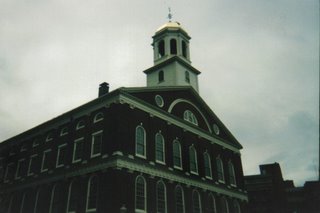
Here is the outside of Faneuil Hall, located right next to Quincy Market and near the old Boston Customs House.
- I am definitely going to visit Boston again. Probably the next chance I will have will be in October, during our fall break. My mom and dad might go with me, or I can try and get some friends together to go. Either way, I would like to consider going beyond Boston, maybe spending a day or two in the city, and then going through scenic areas of Connecticut, or maybe Vermont.
- On a more serious note, the will of the people was thwarted again by certain members of the Massachusetts legislature. By a narrow vote, the state constitutional convention voted to recess until November, thus killing any chance for a vote that would put an amendment on the ballot to define marriage as between a man and a woman. It is important to pray for the situation up there in the Commonwealth, that either the people are motivated to vote the obstructionists out of office, or that the current House and Senate members have a change of heart.
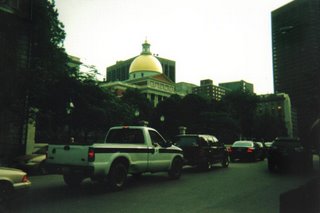
I was there for the convention, spending most of my time inside the Statehouse. I even got to sit in the Gallery for part of the proceedings. The legislature was debating non-same-sex marriage topics like universal health care and the state's rainy day fund, but it was still fascinating to me to see how a legislative session works. Sure, I have watched Congress on C-SPAN before, but like many things, the real experience is being physically present to watch how a session works-how votes are taken, how debate is conducted, and how the process works.
This is the Great Hall inside the Statehouse; on the walls are the flags of every city and town in Massachusetts.

Also, the Statehouse gallery in Boston is absolutely beautifully decorated-I wasn't allowed to take pictures inside, but the wall behind the podium contains a mural of "Milestones on the Road to Freedom in Massachusetts." The events chronicled include the receipt of the city's charter in 1630, Judge Sewall's public apology following the Salem witch trials, and John Hancock's proposal of the Bill of Rights during the 1787 Constitutional Convention.
In the Senate chamber, there is a banner over the podium reading "God Save the Commonwealth of Massachusetts." The room is full of history-you can almost breathe it in when you enter inside. It contains historical artifacts, and busts of famous figures from American and Massachusetts history. The irony was not lost on me as I surveyed the room-surrounded by busts of Lincoln, Washington, and Ben Franklin, these men and women were debating whether to give homosexuals the right to marry. It is the strangest dichotomy-between the Christian Founding Fathers and the rich tapestry of history, and the godless liberalism that has taken over so many people in that state-that it emphasizes the tragedy of so many in our Republic losing their sense of Biblical values and right and wrong.
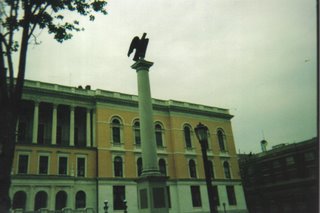
This obelisk was in the garden on the lawn behind the Statehouse; the eagle's wings represent the answered prayers of the Revolutionary generation.
We need to pray again, so that God will hear us and forgive our country's sin-not just the sins of the people on the "other side", but the lack of love and compassion we Christians have sometimes shown for those who are in the gay lifestyle, and for those who do not know the Lord.
- This is not directly related to Boston, but while I was there, I got some fantastic news-I will be a staff member on the Ohio State Law Journal next year. I'm not sure yet what I want to write my note on, but I plan to decide by next month. Suffice it to say that it will involve constitutional law, and an issue such as religious liberty or the sanctity of life-I am eager to expand my knowledge and scholastic credentials, and get to work.
- Boston is very rich in history. I was only there for a few days, so I didn't have time to really tour the city, but I did get to see a few historical sites the day I left. My favorite was probably Boston Common, which I saw on the way to the Statehouse on Tuesday, walking up Beacon Hill. I also got to walk through Faneuil Hall, the Old North Church, and I saw Paul Revere's house. The north end of Boston is a nice touristy area, full of narrow streets, shops, and restaurants. The Old North Church and the Revere house are in Little Italy-there were scores of Italian restaurants and coffee shops, so I will have to try one or two the next time I am there.
Here is the outside of Faneuil Hall, located right next to Quincy Market and near the old Boston Customs House.

- I am definitely going to visit Boston again. Probably the next chance I will have will be in October, during our fall break. My mom and dad might go with me, or I can try and get some friends together to go. Either way, I would like to consider going beyond Boston, maybe spending a day or two in the city, and then going through scenic areas of Connecticut, or maybe Vermont.
- On a more serious note, the will of the people was thwarted again by certain members of the Massachusetts legislature. By a narrow vote, the state constitutional convention voted to recess until November, thus killing any chance for a vote that would put an amendment on the ballot to define marriage as between a man and a woman. It is important to pray for the situation up there in the Commonwealth, that either the people are motivated to vote the obstructionists out of office, or that the current House and Senate members have a change of heart.
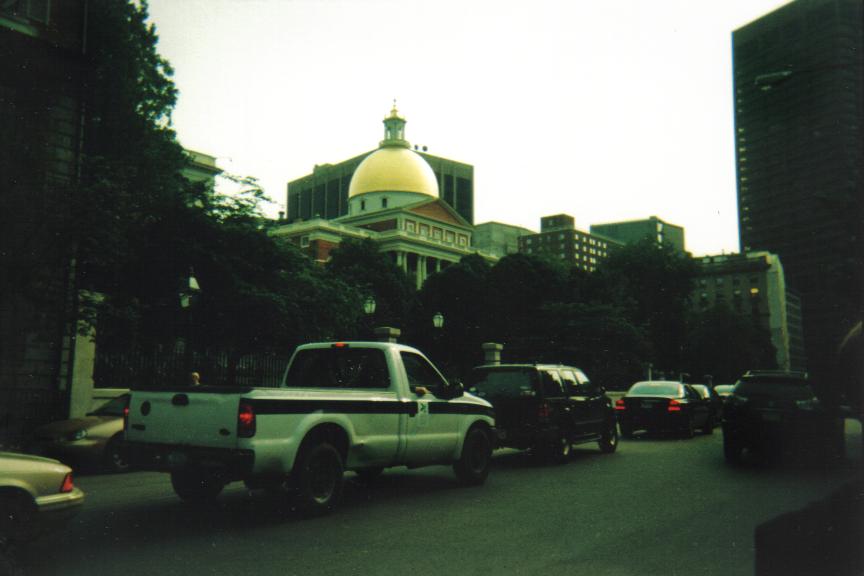
I was there for the convention, spending most of my time inside the Statehouse. I even got to sit in the Gallery for part of the proceedings. The legislature was debating non-same-sex marriage topics like universal health care and the state's rainy day fund, but it was still fascinating to me to see how a legislative session works. Sure, I have watched Congress on C-SPAN before, but like many things, the real experience is being physically present to watch how a session works-how votes are taken, how debate is conducted, and how the process works.
This is the Great Hall inside the Statehouse; on the walls are the flags of every city and town in Massachusetts.

Also, the Statehouse gallery in Boston is absolutely beautifully decorated-I wasn't allowed to take pictures inside, but the wall behind the podium contains a mural of "Milestones on the Road to Freedom in Massachusetts." The events chronicled include the receipt of the city's charter in 1630, Judge Sewall's public apology following the Salem witch trials, and John Hancock's proposal of the Bill of Rights during the 1787 Constitutional Convention.
In the Senate chamber, there is a banner over the podium reading "God Save the Commonwealth of Massachusetts." The room is full of history-you can almost breathe it in when you enter inside. It contains historical artifacts, and busts of famous figures from American and Massachusetts history. The irony was not lost on me as I surveyed the room-surrounded by busts of Lincoln, Washington, and Ben Franklin, these men and women were debating whether to give homosexuals the right to marry. It is the strangest dichotomy-between the Christian Founding Fathers and the rich tapestry of history, and the godless liberalism that has taken over so many people in that state-that it emphasizes the tragedy of so many in our Republic losing their sense of Biblical values and right and wrong.
This obelisk was in the garden on the lawn behind the Statehouse; the eagle's wings represent the answered prayers of the Revolutionary generation.
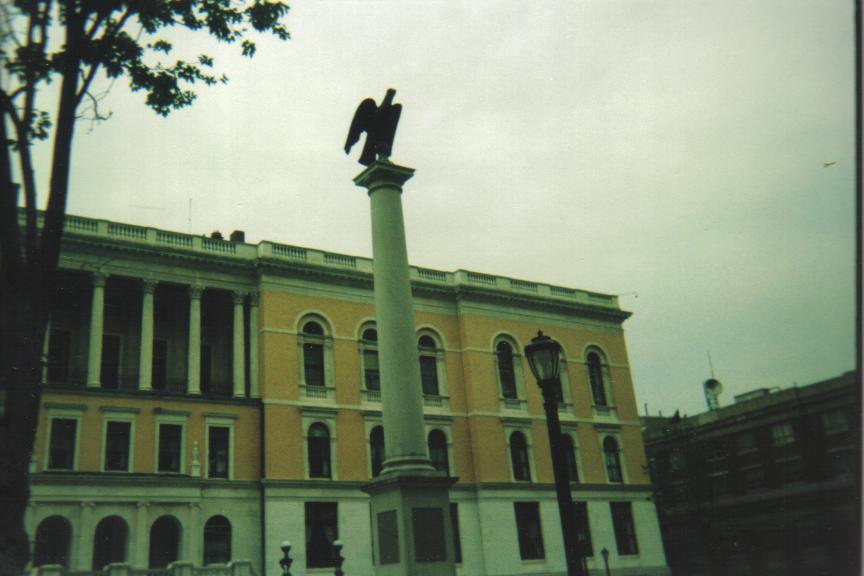
We need to pray again, so that God will hear us and forgive our country's sin-not just the sins of the people on the "other side", but the lack of love and compassion we Christians have sometimes shown for those who are in the gay lifestyle, and for those who do not know the Lord.
- This is not directly related to Boston, but while I was there, I got some fantastic news-I will be a staff member on the Ohio State Law Journal next year. I'm not sure yet what I want to write my note on, but I plan to decide by next month. Suffice it to say that it will involve constitutional law, and an issue such as religious liberty or the sanctity of life-I am eager to expand my knowledge and scholastic credentials, and get to work.
Sunday, July 09, 2006
Summer of 2006, pt. 6
Dispatches from Columbus, since I am staying at my apartment this weekend:
- Cincinnati is a nice city. I had only been through the city once before this summer, coming home from a trip to Florida, and I didn't get a chance to see it. This past week, I went downtown with the attorney I am working for to observe a deposition, and I got to see the area down by the river. Some of the landmarks I plan to visit: the Taft House and Museum, the Newport Aquarium, the Cincinnati Zoo, and of course go to a Reds game. There is an area on the Kentucky side of the river, called Newport-on-the-Levee, that has stores, restaurants, etc., kind of like Easton here in Columbus.
- I met with my treasurer today to discuss our plans for the Moritz chapter of the Christian Legal Society. We are planning to focus on reaching out and serving-the components of integrating our faith with our work as law students and, soon to come, lawyers.
Every other Thursday night throughout the semester, we will be having a Bible study, that is open to all students. We are still discussing topics, but my goal is to make all parts of Scripture relevant to our lives as Christians, not just as law students. I plan to cover topics that may have seemed “off limits” to Christians in the past. For example, what does the Bible have to say about our use of the Internet and modern technology? What does the Word say about what we should do in our spare time? There are countless ways to relate the Bible to everyday life, and I intend to use them as a way for us to relate to each other as Christians moving with confidence through law school, the trial of our faith.
We will also be looking for ways to serve others. For this, we have to find a way to get out of our comfort zones and address the needs of a world around us that is starving for the Gospel, and for the saving grace of Jesus Christ. More to be announced soon, but suffice it to say that where God leads us, we will follow.
One other point I plan to emphasize this year is that everyone, regardless of denomination, theological or political beliefs, or even whether believers or not, is welcome at Christian Legal Society. I want to emphasize this not to water down the message of Christ, but to show how relevant it is to everyone who walks through the door. Each of us is responsible, in our own way, for putting Christ on the cross, and we all need His forgiveness. My task, as president of the group, is not only to provide leadership and direction for our community of faith, but to create the conditions where the Holy Spirit can work in our hearts, and where everyone knows they are loved and being prayed for.
Look for more updates on Christian Legal Society coming this fall.
- Good news for the Cavs: LeBron James agreed to the contract extension today, which means he will be playing in Cleveland through the 2012-2013 season. This is some of the best news Cleveland sports fans like me can get right now, because I said earlier that as long as the Cavs can sign LeBron long-term, they will have an excellent shot at winning a championship, provided they keep a solid core of talent around him.
Now they need to re-sign Drew Gooden, and settle the situation at guard. The two new draft picks sound like they could be contributors next season, and they will need to find an impact player to replace Flip Murray, who will be leaving through free agency. Ultimately, though, the future looks promising, and I have a feeling the next great rivalry in the Eastern Conference will be between the LeBron-led Cavs and the Dwayne Wade-led Heat.
- Cincinnati is a nice city. I had only been through the city once before this summer, coming home from a trip to Florida, and I didn't get a chance to see it. This past week, I went downtown with the attorney I am working for to observe a deposition, and I got to see the area down by the river. Some of the landmarks I plan to visit: the Taft House and Museum, the Newport Aquarium, the Cincinnati Zoo, and of course go to a Reds game. There is an area on the Kentucky side of the river, called Newport-on-the-Levee, that has stores, restaurants, etc., kind of like Easton here in Columbus.
- I met with my treasurer today to discuss our plans for the Moritz chapter of the Christian Legal Society. We are planning to focus on reaching out and serving-the components of integrating our faith with our work as law students and, soon to come, lawyers.
Every other Thursday night throughout the semester, we will be having a Bible study, that is open to all students. We are still discussing topics, but my goal is to make all parts of Scripture relevant to our lives as Christians, not just as law students. I plan to cover topics that may have seemed “off limits” to Christians in the past. For example, what does the Bible have to say about our use of the Internet and modern technology? What does the Word say about what we should do in our spare time? There are countless ways to relate the Bible to everyday life, and I intend to use them as a way for us to relate to each other as Christians moving with confidence through law school, the trial of our faith.
We will also be looking for ways to serve others. For this, we have to find a way to get out of our comfort zones and address the needs of a world around us that is starving for the Gospel, and for the saving grace of Jesus Christ. More to be announced soon, but suffice it to say that where God leads us, we will follow.
One other point I plan to emphasize this year is that everyone, regardless of denomination, theological or political beliefs, or even whether believers or not, is welcome at Christian Legal Society. I want to emphasize this not to water down the message of Christ, but to show how relevant it is to everyone who walks through the door. Each of us is responsible, in our own way, for putting Christ on the cross, and we all need His forgiveness. My task, as president of the group, is not only to provide leadership and direction for our community of faith, but to create the conditions where the Holy Spirit can work in our hearts, and where everyone knows they are loved and being prayed for.
Look for more updates on Christian Legal Society coming this fall.
- Good news for the Cavs: LeBron James agreed to the contract extension today, which means he will be playing in Cleveland through the 2012-2013 season. This is some of the best news Cleveland sports fans like me can get right now, because I said earlier that as long as the Cavs can sign LeBron long-term, they will have an excellent shot at winning a championship, provided they keep a solid core of talent around him.
Now they need to re-sign Drew Gooden, and settle the situation at guard. The two new draft picks sound like they could be contributors next season, and they will need to find an impact player to replace Flip Murray, who will be leaving through free agency. Ultimately, though, the future looks promising, and I have a feeling the next great rivalry in the Eastern Conference will be between the LeBron-led Cavs and the Dwayne Wade-led Heat.
Boston Common
So it looks as though I am going to get to go to Boston after all. I wasn’t sure until a couple of days ago, because lodging and transportation is really hard to get up there because of all the tourism. But I leave Monday afternoon, and I am really excited about seeing the city and all the events which will transpire. The attorney I am working for is involved with the battle over same-sex marriage in Massachusetts, and I will be there to observe and do any work needed.
Next Wednesday, the Massachusetts legislature, known as the General Court, will convene in a joint session to consider a proposed constitutional amendment, under which marriage would be defined as one man and one woman. It has come before the legislature in the past, but supporters of same-sex marriage have used procedural tactics to block passage, and it is possible that they will do so again. The marriage amendment did not originate with the legislature, however-it was proposed directly by the people, under the initiative process outlined in article 48 of the state constitution.
Massachusetts is one of the few states, as far as I know, that requires a law proposed by initiative (voters circulating a petition) to be approved by the legislature before it goes on the ballot. Since it is a constitutional amendment being submitted, it needs an affirmative vote from 25% of the members of the General Court to get on the ballot during the next November general election. Since there are 160 members of the House and 40 members of the Senate, at least 50 members must vote for the amendment for the measure to go forward. The operative word here is “vote,” since one of the issues is whether the legislature will give the proposed amendment an up-or-down vote, or adjourn before a vote can be taken, as has been done in the past.
Right now, Massachusetts is the only state in the Union where same-sex marriage is legal. It was established by judicial fiat back in 2003, in Goodridge v. Department of Public Health, 798 N.E.2d 941 (Mass. 2003). Vermont and Connecticut allow civil unions, which provide benefits to gay couples without issuing marriage licenses.
Another factor is the recent decision issued out of New York, victories for those of us who want to keep traditional marriage. A separate decision was issued in Georgia, upholding a ban on gay marriage under that state’s ballot initiative laws. But it is unclear how (or if) these cases will impact what happens in Boston next week.
The New York case, actually four cases grouped together, appears to be a model for how the courts should be approaching this subject. I am genuinely shocked to be saying that about the Empire State, given the apparent predominance of so-called “progressives” like Judith Kaye on the court there, but the ruling handed down this week appears to be an exception. In the opinion written by Judge Robert Smith, the New York Court of Appeals found that there is no state constitutional requirement to give homosexual couples the right to marry.
The case dealt with the assertion of forty-four same-sex couples that the state’s Domestic Relations Law, dating back to 1909, which governs marriage in the state of New York, grants the right to marry to two people of the same gender. Even though there is no gender-specific language specifying that a man must marry a woman, and vice versa, the court noted, “that was the universal understanding when Articles 2 and 3 [dealing with marriage] were adopted.” 86-89, p. 2.
It is refreshing to see an opinion particularly coming out of such an influential jurisdiction as New York, that rejects the notion that same-sex marriage is the end product of a long-standing “progression” of civil rights. The prevailing sense of “do-what-you-feel” radical individualism that has taken root in so many places will ultimately not only disrupt and weaken society, but degrade the very people whom it was meant to satisfy.
The Court of Appeal’s decision is also a shining example of judicial restraint, a concept that sorely needs to be revived in order to honor the will of the people on this issue. Judge Smith, writing for a 4-2 majority, reasoned that (quoting from foxnews.com): “we do not predict what people will think generations from now, but we believe the present generation should have a chance to decide the issue through its elected representatives.”
Any opposition to letting the people decide seems to be rooted in this fear that the desired outcome-a radical change in social policy-will not be forthcoming. But the basic idea behind representative government, and our Republic, is that the people have a say in their own individual and collective destinies. If this includes a belief that certain institutions, such as traditional marriage, are sacred and transcend some court order, then that point of view deserves respect.
It deserves its day in court.
Sources: http://www.courts.state.ny.us/ctapps/decisions/jul06/86-89opn06.pdf; http://www.foxnews.com/story/0,2933,202339,00.html
Next Wednesday, the Massachusetts legislature, known as the General Court, will convene in a joint session to consider a proposed constitutional amendment, under which marriage would be defined as one man and one woman. It has come before the legislature in the past, but supporters of same-sex marriage have used procedural tactics to block passage, and it is possible that they will do so again. The marriage amendment did not originate with the legislature, however-it was proposed directly by the people, under the initiative process outlined in article 48 of the state constitution.
Massachusetts is one of the few states, as far as I know, that requires a law proposed by initiative (voters circulating a petition) to be approved by the legislature before it goes on the ballot. Since it is a constitutional amendment being submitted, it needs an affirmative vote from 25% of the members of the General Court to get on the ballot during the next November general election. Since there are 160 members of the House and 40 members of the Senate, at least 50 members must vote for the amendment for the measure to go forward. The operative word here is “vote,” since one of the issues is whether the legislature will give the proposed amendment an up-or-down vote, or adjourn before a vote can be taken, as has been done in the past.
Right now, Massachusetts is the only state in the Union where same-sex marriage is legal. It was established by judicial fiat back in 2003, in Goodridge v. Department of Public Health, 798 N.E.2d 941 (Mass. 2003). Vermont and Connecticut allow civil unions, which provide benefits to gay couples without issuing marriage licenses.
Another factor is the recent decision issued out of New York, victories for those of us who want to keep traditional marriage. A separate decision was issued in Georgia, upholding a ban on gay marriage under that state’s ballot initiative laws. But it is unclear how (or if) these cases will impact what happens in Boston next week.
The New York case, actually four cases grouped together, appears to be a model for how the courts should be approaching this subject. I am genuinely shocked to be saying that about the Empire State, given the apparent predominance of so-called “progressives” like Judith Kaye on the court there, but the ruling handed down this week appears to be an exception. In the opinion written by Judge Robert Smith, the New York Court of Appeals found that there is no state constitutional requirement to give homosexual couples the right to marry.
The case dealt with the assertion of forty-four same-sex couples that the state’s Domestic Relations Law, dating back to 1909, which governs marriage in the state of New York, grants the right to marry to two people of the same gender. Even though there is no gender-specific language specifying that a man must marry a woman, and vice versa, the court noted, “that was the universal understanding when Articles 2 and 3 [dealing with marriage] were adopted.” 86-89, p. 2.
It is refreshing to see an opinion particularly coming out of such an influential jurisdiction as New York, that rejects the notion that same-sex marriage is the end product of a long-standing “progression” of civil rights. The prevailing sense of “do-what-you-feel” radical individualism that has taken root in so many places will ultimately not only disrupt and weaken society, but degrade the very people whom it was meant to satisfy.
The Court of Appeal’s decision is also a shining example of judicial restraint, a concept that sorely needs to be revived in order to honor the will of the people on this issue. Judge Smith, writing for a 4-2 majority, reasoned that (quoting from foxnews.com): “we do not predict what people will think generations from now, but we believe the present generation should have a chance to decide the issue through its elected representatives.”
Any opposition to letting the people decide seems to be rooted in this fear that the desired outcome-a radical change in social policy-will not be forthcoming. But the basic idea behind representative government, and our Republic, is that the people have a say in their own individual and collective destinies. If this includes a belief that certain institutions, such as traditional marriage, are sacred and transcend some court order, then that point of view deserves respect.
It deserves its day in court.
Sources: http://www.courts.state.ny.us/ctapps/decisions/jul06/86-89opn06.pdf; http://www.foxnews.com/story/0,2933,202339,00.html
Monday, July 03, 2006
Reading: "Original Intent"
On Saturday, I finished reading "Original Intent: The Courts, the Constitution, and Religion" by David Barton. It is based on a simple question, backed up by an incredible amount of historical and primary source material-what were the attitudes of the Founders toward religion, and more specifically, its expressions in public life that are so controversial today?
Barton’s thesis is that based on their public and private writings, the Founders wished to encourage, and not discourage, religious expression in the public square. Rather than being deists, agnostics, or atheists, nearly all were members of some Christian denomination. These men viewed religion, especially Christianity, as a force for good and vital to a free and prosperous society.
To help demonstrate where the Founders stood, and address some popularly held views on the subject, Barton has assembled a tremendous amount of data. Here are some thoughts I had after reading:
One of the reasons I highly recommend this book is for its use of primary sources. Each of the 18 chapters is packed with hundreds of quotes from the Founding Fathers’ statements, letters, public proclamations, judicial opinions, and other sources. “Original Intent,” in my opinion, really stands out as a historical work because of this attention to the original sources. Barton clearly lets the Founders speak for themselves, and does not devote excessive time to his own analysis. It allows the reader to draw his or her own conclusions.
Not only is the primary source material top-notch (the only change is to modernize spellings to make materials easier to read), this book will also serve as a way to learn about many of the Founders who are not included in your average public school curriculum today. Just to name a few:
(Also, note that any quotes or material used in this post comes from David Barton’s “Original Intent,” and its citations. The full citation, if you want to find it at the library, is: Barton, David. Original Intent: The Courts, the Constitution, & Religion. Aledo, TX: WallBuilder Press, 2000.)
1) Justice Joseph Story: referred to as one of the “Fathers of American Jurisprudence” along with Chancellor James Kent; founded Harvard Law School and authored 286 opinions in his 34 years on the Supreme Court. “Where can the purest principles of morality be learned so clearly or so perfectly as from the New Testament?” Vidal v. Girard’s Executors, 43 U.S. 126, 200 (1844).
2) James Wilson: one of only six men who signed both the Declaration of Independence and the Constitution. He was one of the six original Supreme Court Justices, appointed by President Washington, and along with Thomas McKean, co-authored the first “Commentaries on the Constitution” in 1792. “Far from being rivals or enemies, religion and law are twin sisters, friends, and mutual assistants.” Elliot’s Debates, Vol. II, p. 413, July 26, 1788.
3) Chancellor James Kent: wrote the four-volume Commentaries on American Law, which became the standard for lawyers-in-training in America throughout the nineteenth century. “[E]very citizen might freely speak, write, and print, on any subject, [but is] responsible for the abuse of that liberty.” Commentaries on American Law (New York: O. Halsted, 1827), Vol. II, pp. 17-18, Lecture XXIV. “Of the Rights of Persons,” quoting the Louisiana constitution, Article VI, §21.
There are scores, maybe hundreds of individuals, and thousands of quotations such as those above, to which the author cites, and he could probably have cited more. At the back of the book, he gives a complete list of biographies of all the individuals discussed in preceding chapters. For purposes of study, on page 8, he defines a “Founding Father” as “one who exerted significant influence in, provided prominent leadership for, or had a substantial impact upon the birth, development, and establishment of America as an independent, self-governing nation.” According to Barton, this encompasses a) the signers of the Declaration of Independence; b) Presidents of Congress during the Revolution; c) prominent Revolutionary generals; d) delegates to the Constitutional Convention; e) early state governors who played a role in the ratification and adoption process; f) members of the First Congress, Supreme Court, and early Executive Branch.
I think that the magnitude of the impact this is likely to have on one’s intellectual approach to that time period underscores how narrow our view of the Founders has become over time. With television, Internet, and our hectic schedules, it is easy to take a quote or two out of context, or gather secondary or even tertiary material, and make a generalization as to the group who wrote the Constitution. I am guilty of this thought pattern to some extent-before I read this, and heard Mr. Barton speak at Phase I of the Blackstone, I believed that the Founders were divided between secularist and more traditionally Christian attitudes on matters of religion. Now, even though I am still forming my own opinions, it appears as though they spoke with a more unified voice than I realized, one that sounds radically different from those calling for “separation of church and state” today.
One other feature of this book to check out is the last three chapters, or any other part of the book that deals with many of the misconceptions people hold about what the Founders believed. One chapter, entitled “Revisionism: A Willing Accomplice,” deals not only with the historical inaccuracies that are out there regarding the Founding generation (i.e. Jefferson’s letter to the Danbury Baptists meant to assure them that the federal government would not interfere with their free exercise rights, not that it must intervene to prevent them in public), but with personal attacks designed to discredit them in their role in history (i.e. the slavery issue is discussed at some length). This is a strong resource for re-examining much of the “conventional wisdom” and historical knowledge that is in the public arena today.
Overall…a very fulfilling read, and well worth your time if you have an interest in law, particularly constitutional law, American history, and its implications for public policy issues. It may take about 10-12 hours to read, since it is about 350 pages plus appendices. I recommend it to help get the historical context for the culture war being waged in our country today.
Barton’s thesis is that based on their public and private writings, the Founders wished to encourage, and not discourage, religious expression in the public square. Rather than being deists, agnostics, or atheists, nearly all were members of some Christian denomination. These men viewed religion, especially Christianity, as a force for good and vital to a free and prosperous society.
To help demonstrate where the Founders stood, and address some popularly held views on the subject, Barton has assembled a tremendous amount of data. Here are some thoughts I had after reading:
One of the reasons I highly recommend this book is for its use of primary sources. Each of the 18 chapters is packed with hundreds of quotes from the Founding Fathers’ statements, letters, public proclamations, judicial opinions, and other sources. “Original Intent,” in my opinion, really stands out as a historical work because of this attention to the original sources. Barton clearly lets the Founders speak for themselves, and does not devote excessive time to his own analysis. It allows the reader to draw his or her own conclusions.
Not only is the primary source material top-notch (the only change is to modernize spellings to make materials easier to read), this book will also serve as a way to learn about many of the Founders who are not included in your average public school curriculum today. Just to name a few:
(Also, note that any quotes or material used in this post comes from David Barton’s “Original Intent,” and its citations. The full citation, if you want to find it at the library, is: Barton, David. Original Intent: The Courts, the Constitution, & Religion. Aledo, TX: WallBuilder Press, 2000.)
1) Justice Joseph Story: referred to as one of the “Fathers of American Jurisprudence” along with Chancellor James Kent; founded Harvard Law School and authored 286 opinions in his 34 years on the Supreme Court. “Where can the purest principles of morality be learned so clearly or so perfectly as from the New Testament?” Vidal v. Girard’s Executors, 43 U.S. 126, 200 (1844).
2) James Wilson: one of only six men who signed both the Declaration of Independence and the Constitution. He was one of the six original Supreme Court Justices, appointed by President Washington, and along with Thomas McKean, co-authored the first “Commentaries on the Constitution” in 1792. “Far from being rivals or enemies, religion and law are twin sisters, friends, and mutual assistants.” Elliot’s Debates, Vol. II, p. 413, July 26, 1788.
3) Chancellor James Kent: wrote the four-volume Commentaries on American Law, which became the standard for lawyers-in-training in America throughout the nineteenth century. “[E]very citizen might freely speak, write, and print, on any subject, [but is] responsible for the abuse of that liberty.” Commentaries on American Law (New York: O. Halsted, 1827), Vol. II, pp. 17-18, Lecture XXIV. “Of the Rights of Persons,” quoting the Louisiana constitution, Article VI, §21.
There are scores, maybe hundreds of individuals, and thousands of quotations such as those above, to which the author cites, and he could probably have cited more. At the back of the book, he gives a complete list of biographies of all the individuals discussed in preceding chapters. For purposes of study, on page 8, he defines a “Founding Father” as “one who exerted significant influence in, provided prominent leadership for, or had a substantial impact upon the birth, development, and establishment of America as an independent, self-governing nation.” According to Barton, this encompasses a) the signers of the Declaration of Independence; b) Presidents of Congress during the Revolution; c) prominent Revolutionary generals; d) delegates to the Constitutional Convention; e) early state governors who played a role in the ratification and adoption process; f) members of the First Congress, Supreme Court, and early Executive Branch.
I think that the magnitude of the impact this is likely to have on one’s intellectual approach to that time period underscores how narrow our view of the Founders has become over time. With television, Internet, and our hectic schedules, it is easy to take a quote or two out of context, or gather secondary or even tertiary material, and make a generalization as to the group who wrote the Constitution. I am guilty of this thought pattern to some extent-before I read this, and heard Mr. Barton speak at Phase I of the Blackstone, I believed that the Founders were divided between secularist and more traditionally Christian attitudes on matters of religion. Now, even though I am still forming my own opinions, it appears as though they spoke with a more unified voice than I realized, one that sounds radically different from those calling for “separation of church and state” today.
One other feature of this book to check out is the last three chapters, or any other part of the book that deals with many of the misconceptions people hold about what the Founders believed. One chapter, entitled “Revisionism: A Willing Accomplice,” deals not only with the historical inaccuracies that are out there regarding the Founding generation (i.e. Jefferson’s letter to the Danbury Baptists meant to assure them that the federal government would not interfere with their free exercise rights, not that it must intervene to prevent them in public), but with personal attacks designed to discredit them in their role in history (i.e. the slavery issue is discussed at some length). This is a strong resource for re-examining much of the “conventional wisdom” and historical knowledge that is in the public arena today.
Overall…a very fulfilling read, and well worth your time if you have an interest in law, particularly constitutional law, American history, and its implications for public policy issues. It may take about 10-12 hours to read, since it is about 350 pages plus appendices. I recommend it to help get the historical context for the culture war being waged in our country today.
Summer of 2006, pt. 5
I’m back home now, after a busy two weeks.
On the 23rd, I flew back from Phase I. A lot of us had a layover in Memphis on the way to our Phase II destination, so I got to see the Mississippi River from the air. Not much time after landing, though-we got delayed in Phoenix, so I had to rush from one gate to another to take the flight home.
Last week was my first week at work in Cincinnati. It has been a great experience so far- my first job at a private law firm, after a couple of legal internships with UA’s Office of General Counsel and the local prosecutor’s office during my undergraduate years. I have only been on the job a few days so far, but the time spent is valuable because I am learning directly from the attorneys, who live the law day in and day out. There is no better way to learn “how to be a lawyer,” even with all the theory and substantive knowledge that textbooks can offer.
This is not to diminish the classroom, because law school in general, and the first year in particular, is where you get the “skeleton” of the law, and I have had some outstanding professors to guide me through the transition. But there is nothing like the satisfaction I get from an honest day’s work. No matter where I work, and no matter how my talents are employed next summer, and in 2008, I know that I labor for God.
Plus, I like knowing that learning through working, and through observation, is still part of the rite of passage of becoming a lawyer, and it feels good to be a part of that. It gives you a rush to know that when you learn on the job, by researching or observing, you are following in the footsteps of Coke, Blackstone, Jefferson, Marshall, Story, and you are becoming a part of America’s legal system. Every time I get frustrated with what I don’t yet understand, concerned with the vast amount which I do not know, I remember that even with as brilliant as they were, each of those jurists had to start somewhere.
With my Phase II placement in Cincinnati, I was able to drive home for the weekend. On Saturday, I got to sleep in, and then go play miniature golf with my brother and his wife, and my friend Rachel. Not much happening today-the rain put most of our plans on hold. I was supposed to go fishing with my dad and brother this morning, but we put it off until tomorrow because of a thunderstorm. Same thing with fireworks-a strong storm blew through the area about 9:00, so we will have to go tomorrow.
On the 23rd, I flew back from Phase I. A lot of us had a layover in Memphis on the way to our Phase II destination, so I got to see the Mississippi River from the air. Not much time after landing, though-we got delayed in Phoenix, so I had to rush from one gate to another to take the flight home.
Last week was my first week at work in Cincinnati. It has been a great experience so far- my first job at a private law firm, after a couple of legal internships with UA’s Office of General Counsel and the local prosecutor’s office during my undergraduate years. I have only been on the job a few days so far, but the time spent is valuable because I am learning directly from the attorneys, who live the law day in and day out. There is no better way to learn “how to be a lawyer,” even with all the theory and substantive knowledge that textbooks can offer.
This is not to diminish the classroom, because law school in general, and the first year in particular, is where you get the “skeleton” of the law, and I have had some outstanding professors to guide me through the transition. But there is nothing like the satisfaction I get from an honest day’s work. No matter where I work, and no matter how my talents are employed next summer, and in 2008, I know that I labor for God.
Plus, I like knowing that learning through working, and through observation, is still part of the rite of passage of becoming a lawyer, and it feels good to be a part of that. It gives you a rush to know that when you learn on the job, by researching or observing, you are following in the footsteps of Coke, Blackstone, Jefferson, Marshall, Story, and you are becoming a part of America’s legal system. Every time I get frustrated with what I don’t yet understand, concerned with the vast amount which I do not know, I remember that even with as brilliant as they were, each of those jurists had to start somewhere.
With my Phase II placement in Cincinnati, I was able to drive home for the weekend. On Saturday, I got to sleep in, and then go play miniature golf with my brother and his wife, and my friend Rachel. Not much happening today-the rain put most of our plans on hold. I was supposed to go fishing with my dad and brother this morning, but we put it off until tomorrow because of a thunderstorm. Same thing with fireworks-a strong storm blew through the area about 9:00, so we will have to go tomorrow.
Thursday, June 29, 2006
The Reading List
Now that I have attended Phase I of the Blackstone, I plan to greatly increase my extracurricular reading, either for learning or entertainment. Right now, I am reading David Barton's "Original Intent: The Courts, the Constitution, & Religion," about the Founding Fathers and their attitudes on the role of Christianity and religious principles as applied to the First Amendment and civic government. I am about 60% of the way through it, and will have a post about it soon.
Also, any new posts about "Reading" will just have the name of the book, instead of "part 3," "part 4," and so on. This is so I can balance my learning between history, law, Christian apologetics, fiction, and other related fields.
It is difficult to keep up with all of the books I want to read, particularly those that were recommended to us during Phase I. It seemed as though after every speaker gave his or her presentation, I had about 3 or 4 new books to add to the list. But even if it takes the rest of law school, I plan to read them all. For now, though, here are some of the books I plan to make a priority to read before the end of the year:
Blackstone's "Commentaries."
"Christianity and the American Commonwealth" by Charles Galloway.
"Christianity and Culture" by J. Gresham Machen.
"Rhetoric" by Aristotle.
"Prince Caspian" and any other entries in the "Narnia" series, by C.S. Lewis.
Also, any new posts about "Reading" will just have the name of the book, instead of "part 3," "part 4," and so on. This is so I can balance my learning between history, law, Christian apologetics, fiction, and other related fields.
It is difficult to keep up with all of the books I want to read, particularly those that were recommended to us during Phase I. It seemed as though after every speaker gave his or her presentation, I had about 3 or 4 new books to add to the list. But even if it takes the rest of law school, I plan to read them all. For now, though, here are some of the books I plan to make a priority to read before the end of the year:
Blackstone's "Commentaries."
"Christianity and the American Commonwealth" by Charles Galloway.
"Christianity and Culture" by J. Gresham Machen.
"Rhetoric" by Aristotle.
"Prince Caspian" and any other entries in the "Narnia" series, by C.S. Lewis.
Monday, June 19, 2006
Summer of 2006, pt. 4
As I write tonight, my soul is at rest in the midst of a storm.
I am sitting by the pool in Phoenix. It is 10:00 at night here, and about 95 degrees and humid. It's not the heat that surprises me, it's the humidity. This is about the driest place on earth this side of the Sahara.
But regardless of the weather, I feel as though I have finally reached the intersection of my faith in the Lord and my decision to become a lawyer. I have been at Phase I of the Blackstone Fellowship for about a week now, and I have realized simply that this is where I was always meant to be-surrounded by fellowship with fellow Christians who care about God, who want to serve God, and who realize how much all of us, believers or not, are loved by God.
Take today. We had a church service this morning in the meeting room of the hotel. A pastor from the Alliance Defense Fund came in to speak, and two of the interns stepped up and did the music. It was so pure, such an expression of our love for God and God's enduring love for us. One intern played the piano, and one led the singing. We stumbled on the words, and probably the only song we did perfectly was "Amazing Grace." But my heart was in it, and I realized what it means when two or three are gathered in His name.
At the end, we sang a simple song-"Jesus Loves Me." It drove directly to the heart of the Gospel-regardless of our sins, regardless of what I got this semester in Constitutional Law or Property or Legislation, God will love me the same. Just realizing the enormity of what this means could take a lifetime. If you realize this truth, why worry about anything else?
This message could not have been more timely. After God had been working on my heart all week, helping me crack the exterior of selfishness, pride, and what I thought was self-sufficiency, Satan counter-attacked yesterday, blasting me to feel "concern" over my academic report from this past semester. "You can't control things anymore, Brian," he hissed at me. "If you come back with even one bad grade, in a 4-credit class like Property, it will shut the door on your success." Anxiety gripped my heart like a hand around my throat.
But I will have faith, and with God's help will fight off the Enemy's deception.
I cannot do a single thing to either affect my first-year grades, or to get onto a law journal next year. I will work with what I have, and do the best I can with the time and resources available to me.
But do you know what? It's not about me anymore.
It's not about landing the "right" job in some far-off metropolis where I drag in a big, fat paycheck to come home to some empty apartment and see my family twice a year. It's not about spending all these tears and treasure in school so that I make myself into a mercenary to build my own kingdom. So let the grades fall where they may. Because I have realized a simple but earth-shattering truth this week: God is not limited by my grades or achievements. He is only limited by my faith. And if God wants to open a door for me, no power of this world, or of Hell, can keep it closed. I do not say this out of arrogance, just a simple realization and acceptance that He is in control of my life-not myself.
Another example of my soul being at rest is tonight. I am writing this at a table on a patio overlooking the pool. Fellow believers are singing songs of praise in the background as we enjoy each other's company. Tonight I recognize and worship my Lord and Savior, Jesus Christ, for bringing me to this place. He is the One who made this opportunity possible, that got me safely here, by airplane, van, and car, and is watching over the steps of my very existence. Why be afraid anymore? All I need is to stay this connected forever.
My soul is at rest just realizing the impact the last seven days have had upon me. It is mind-boggling. I realize that I can never return to the way things were before, even if I wanted them to. I was a prideful, self-righteous young man who was scared of having to keep up with his own expectations, and the myth of his own self-sufficiency. But I have realized I do not have to live that way anymore.
Most of my spiritual life, beginning not long after I accepted Christ, has been a game of trying to "escape" the life and the personal ministry to which I have been called, all out of laziness, shame, or another selfish motive. Instead of reading my Bible, I would eat another sandwich; instead of thinking about the calling He had placed upon my heart, I would immerse myself in Halo to the point of zombification.
Lord, let me hold tight to You forever. No more games. I will always run the race, but let me conquer my sinful hesitance to pursue Your Truth. I have just begun to do that; it took coming to the desert to get me to stop wandering in the desert. In this, in You, I will find my rest.
I am sitting by the pool in Phoenix. It is 10:00 at night here, and about 95 degrees and humid. It's not the heat that surprises me, it's the humidity. This is about the driest place on earth this side of the Sahara.
But regardless of the weather, I feel as though I have finally reached the intersection of my faith in the Lord and my decision to become a lawyer. I have been at Phase I of the Blackstone Fellowship for about a week now, and I have realized simply that this is where I was always meant to be-surrounded by fellowship with fellow Christians who care about God, who want to serve God, and who realize how much all of us, believers or not, are loved by God.
Take today. We had a church service this morning in the meeting room of the hotel. A pastor from the Alliance Defense Fund came in to speak, and two of the interns stepped up and did the music. It was so pure, such an expression of our love for God and God's enduring love for us. One intern played the piano, and one led the singing. We stumbled on the words, and probably the only song we did perfectly was "Amazing Grace." But my heart was in it, and I realized what it means when two or three are gathered in His name.
At the end, we sang a simple song-"Jesus Loves Me." It drove directly to the heart of the Gospel-regardless of our sins, regardless of what I got this semester in Constitutional Law or Property or Legislation, God will love me the same. Just realizing the enormity of what this means could take a lifetime. If you realize this truth, why worry about anything else?
This message could not have been more timely. After God had been working on my heart all week, helping me crack the exterior of selfishness, pride, and what I thought was self-sufficiency, Satan counter-attacked yesterday, blasting me to feel "concern" over my academic report from this past semester. "You can't control things anymore, Brian," he hissed at me. "If you come back with even one bad grade, in a 4-credit class like Property, it will shut the door on your success." Anxiety gripped my heart like a hand around my throat.
But I will have faith, and with God's help will fight off the Enemy's deception.
I cannot do a single thing to either affect my first-year grades, or to get onto a law journal next year. I will work with what I have, and do the best I can with the time and resources available to me.
But do you know what? It's not about me anymore.
It's not about landing the "right" job in some far-off metropolis where I drag in a big, fat paycheck to come home to some empty apartment and see my family twice a year. It's not about spending all these tears and treasure in school so that I make myself into a mercenary to build my own kingdom. So let the grades fall where they may. Because I have realized a simple but earth-shattering truth this week: God is not limited by my grades or achievements. He is only limited by my faith. And if God wants to open a door for me, no power of this world, or of Hell, can keep it closed. I do not say this out of arrogance, just a simple realization and acceptance that He is in control of my life-not myself.
Another example of my soul being at rest is tonight. I am writing this at a table on a patio overlooking the pool. Fellow believers are singing songs of praise in the background as we enjoy each other's company. Tonight I recognize and worship my Lord and Savior, Jesus Christ, for bringing me to this place. He is the One who made this opportunity possible, that got me safely here, by airplane, van, and car, and is watching over the steps of my very existence. Why be afraid anymore? All I need is to stay this connected forever.
My soul is at rest just realizing the impact the last seven days have had upon me. It is mind-boggling. I realize that I can never return to the way things were before, even if I wanted them to. I was a prideful, self-righteous young man who was scared of having to keep up with his own expectations, and the myth of his own self-sufficiency. But I have realized I do not have to live that way anymore.
Most of my spiritual life, beginning not long after I accepted Christ, has been a game of trying to "escape" the life and the personal ministry to which I have been called, all out of laziness, shame, or another selfish motive. Instead of reading my Bible, I would eat another sandwich; instead of thinking about the calling He had placed upon my heart, I would immerse myself in Halo to the point of zombification.
Lord, let me hold tight to You forever. No more games. I will always run the race, but let me conquer my sinful hesitance to pursue Your Truth. I have just begun to do that; it took coming to the desert to get me to stop wandering in the desert. In this, in You, I will find my rest.
Wednesday, June 14, 2006
Summer of 2006, pt. 3
As I write this, I am in Phoenix, Arizona for the Blackstone Fellowship. I got in on Sunday, flying from Cleveland, and getting to the hotel around noon. Some dispatches about the experience so far:
1) In a nutshell, it has been fantastic, and everything that I had hoped it would be. Each day, we have about 2-3 speakers on various topics, usually one in the morning and one in the afternoon. Today, we had a professor come in and speak on America's Christian history, and the beliefs the Founding Fathers had about the Constitution, religion, and all the issues we deal with today. It was incredibly insightful-I learned things today that had not been revealed in 17 years of school, and I minored in history in college.
2) Phoenix is hot. Right now, it is about 9:10 P.M. here, and it is still probably over 90 degrees outside. The humidity is extremely low, less than 10% usually, so it is hot and dry. I guess I'm just not used to it yet, since I've only been here since Sunday. There is a shopping center across the street from the hotel, and even walking a block or so gives you some exercise and makes you sweaty from the heat. Tomorrow, the high is expected to be 113, and sunny.
3) It is truly amazing how God has brought all of us together for this internship. So far, I have only met 2-3 people from Ohio; we are from all over the country here. My roommate is from Maine, and my smaller group (we are divided into teams of about 10 interns each) has people from Hawaii, Georgia, Iowa, and other places. It is really a testament to God that He made this happen, and He made us get here safe so we could participate in what we are doing here.
4) I have not felt closer to God since high school in the time I have been here. It is a challenge at night to set aside a time for prayer and Bible study, since I am usually exhausted by 10:00 or so (we have to get up at 5:30 AM), but I try to at least read the Bible a little bit each night. Last night, I started on Acts, and then I will read Romans.
That's all I have for now. I will try and post some more as time (and Internet access) allows.
1) In a nutshell, it has been fantastic, and everything that I had hoped it would be. Each day, we have about 2-3 speakers on various topics, usually one in the morning and one in the afternoon. Today, we had a professor come in and speak on America's Christian history, and the beliefs the Founding Fathers had about the Constitution, religion, and all the issues we deal with today. It was incredibly insightful-I learned things today that had not been revealed in 17 years of school, and I minored in history in college.
2) Phoenix is hot. Right now, it is about 9:10 P.M. here, and it is still probably over 90 degrees outside. The humidity is extremely low, less than 10% usually, so it is hot and dry. I guess I'm just not used to it yet, since I've only been here since Sunday. There is a shopping center across the street from the hotel, and even walking a block or so gives you some exercise and makes you sweaty from the heat. Tomorrow, the high is expected to be 113, and sunny.
3) It is truly amazing how God has brought all of us together for this internship. So far, I have only met 2-3 people from Ohio; we are from all over the country here. My roommate is from Maine, and my smaller group (we are divided into teams of about 10 interns each) has people from Hawaii, Georgia, Iowa, and other places. It is really a testament to God that He made this happen, and He made us get here safe so we could participate in what we are doing here.
4) I have not felt closer to God since high school in the time I have been here. It is a challenge at night to set aside a time for prayer and Bible study, since I am usually exhausted by 10:00 or so (we have to get up at 5:30 AM), but I try to at least read the Bible a little bit each night. Last night, I started on Acts, and then I will read Romans.
That's all I have for now. I will try and post some more as time (and Internet access) allows.
Tuesday, June 06, 2006
Summer of 2006, pt. 2
Keeping each one short:
- I have really enjoyed the last two weeks or so. The only time when things have gotten dull was when I wasn't home; I drove down to the apartment over the weekend to go to dinner with some friends and have a meeting for CLS.
So far during this break, we have done a lot; went to the Cleveland Zoo (my favorite animal is the lion), went to the Aeros game (the Akron Aeros are the Indians' AA team, and we're going again Thursday), and have had plenty of time to go swimming at my brother's house. It has really been a fantastic break, and I am alternating my time between relaxing and studying for the Blackstone.
- It doesn't look like the Indians are going anywhere, unless they can get another winning streak going like they did last year. The offense is decent, but they need more than two pitchers (Sabathia and Wickman) to step up and carry the load. Plus, the Central Division just keeps getting tougher, since now Detroit seems like a legitimate contender. If they don't start winning soon, it will all be over by the All-Star Break, winning streak or not.
- Despite what my friend Aaron (the Steelers fan) says, I have high hopes for the Browns this year. I think Savage, the GM, seems to know what he's doing, by bringing together what looks like the beginning of a solid offensive line. Ultimately, it all comes down to Charlie Frye. If he has a breakout year, and he has a chance to with Winslow and Braylon Edwards back, you just might see the Browns in the playoffs.
- I was disappointed that the Cavs couldn't knock off Detroit in the playoffs, but they'll be back next year. If they can sign LeBron James long term, I think he will lead them to a championship, assuming they keep a solid team around him. Here are my predictions: LeBron will sign another five-year deal to stay in Cleveland, the Cavs will trade Z, possibly for an elite point guard and scorer (I heard Allen Iverson, but that's unlikely), and the Cavs will win 50-55 games next year. I'm not going to make a prediction on the playoffs, though-anything can happen.
- I am going to have some pictures on here when I post while in Phoenix, so stay tuned for more posts.
- I have really enjoyed the last two weeks or so. The only time when things have gotten dull was when I wasn't home; I drove down to the apartment over the weekend to go to dinner with some friends and have a meeting for CLS.
So far during this break, we have done a lot; went to the Cleveland Zoo (my favorite animal is the lion), went to the Aeros game (the Akron Aeros are the Indians' AA team, and we're going again Thursday), and have had plenty of time to go swimming at my brother's house. It has really been a fantastic break, and I am alternating my time between relaxing and studying for the Blackstone.
- It doesn't look like the Indians are going anywhere, unless they can get another winning streak going like they did last year. The offense is decent, but they need more than two pitchers (Sabathia and Wickman) to step up and carry the load. Plus, the Central Division just keeps getting tougher, since now Detroit seems like a legitimate contender. If they don't start winning soon, it will all be over by the All-Star Break, winning streak or not.
- Despite what my friend Aaron (the Steelers fan) says, I have high hopes for the Browns this year. I think Savage, the GM, seems to know what he's doing, by bringing together what looks like the beginning of a solid offensive line. Ultimately, it all comes down to Charlie Frye. If he has a breakout year, and he has a chance to with Winslow and Braylon Edwards back, you just might see the Browns in the playoffs.
- I was disappointed that the Cavs couldn't knock off Detroit in the playoffs, but they'll be back next year. If they can sign LeBron James long term, I think he will lead them to a championship, assuming they keep a solid team around him. Here are my predictions: LeBron will sign another five-year deal to stay in Cleveland, the Cavs will trade Z, possibly for an elite point guard and scorer (I heard Allen Iverson, but that's unlikely), and the Cavs will win 50-55 games next year. I'm not going to make a prediction on the playoffs, though-anything can happen.
- I am going to have some pictures on here when I post while in Phoenix, so stay tuned for more posts.
Monday, May 29, 2006
Summer of 2006, pt.1
Now that I have been done with exams for a couple of weeks, and finished the journal competition last week, it is a good feeling to reclaim things which I had put on hold around when things got busy down in Columbus. I am at home in Akron now, and it is great to see my family and friends again. I will have a couple weeks off to talk about things besides exams, papers, and all of the trappings of school, even though I know everyone will miss those kind of posts.
Yesterday, I went to a carnival up in Chagrin Falls, near Cleveland, with a couple of friends from Akron U. Most of the things there were geared toward kids, but we got to watch a concert by a really good band that covered the Beatles. They played basically any song you can think of, ending on "Hey Jude." It was really crowded, though-wall to wall people, and at some times the crowd was so big that you couldn't even turn around or go in another direction. I think the entire town was there, at one point or another.
It was a beautiful night, though-hot, but sunny, and we sat in the shade, since the concert was held under a big tent. I walked down the fairway for a while, and I was hungry enough to get a sausage sandwich or piece of pizza, but I didn't want to pay $6, so I ended up with peanuts and water at the gas station later. I guess cutting down on eating kind of got forced upon me. I did have some corn on the cob, though-I can't pass up good corn.
I thought it was funny to go by the tents where all the political candidates were camped out-we went by the Republican Party tent and got "Blackwell for Governor" stickers. I noticed that there was a huge crowd near the Republican tent, but no one was even sitting in the Democrats' booth. I wonder if that means anything about whether we'll be talking about Governor Ted Strickland or Senator Sherrod Brown (that's a whole other post and a lot of angry comments).
By the way, Chagrin Falls is a nice little town. I had never been there before yesterday, and it was the kind of place I hope to settle down in someday, maybe after I retire. I'll go wherever my work leads me, but I have always been a small-town kind of person.
After we left, I went over to my friend Kristin's house and watched "Walk the Line", the movie about the life of Johnny Cash, starring Joaquin Phoenix and Reese Witherspoon, and then drove home.
So it sounds like a pretty normal day, except for the first time probably since I moved to Columbus, I didn't even think about law school. Not for one minute, for several hours. I am thinking a lot about the Blackstone these days-I have a feeling this summer is going to change, shape, and redefine the focus and direction of my life for many years to come. No, for once I stopped thinking about the pressure I have been under, whether I am going to get on to the Ohio State Law Journal, whether I am going to have the grades for on-campus interviewing in the fall, and all the other things I need to learn to let go of and trust God on.
And it was a great feeling.
I have two weeks left before I pack my suitcase and travel to Phoenix for Phase I of the Blackstone Fellowship. I will be posting throughout the summer, as always, but it may get sporadic after the 11th, depending on Internet access and time constraints while I am gone. For the next two weeks, I plan to get my assigned reading done, go swimming at my brother's house, get a sun tan, and basically relax for what will probably be the last time until after I take the bar exam about 26 months from now. I say, bring it on.
Subscribe to:
Posts (Atom)